
Best Areas to Buy Property in Valencia — A 2026 Buyer’s Guide
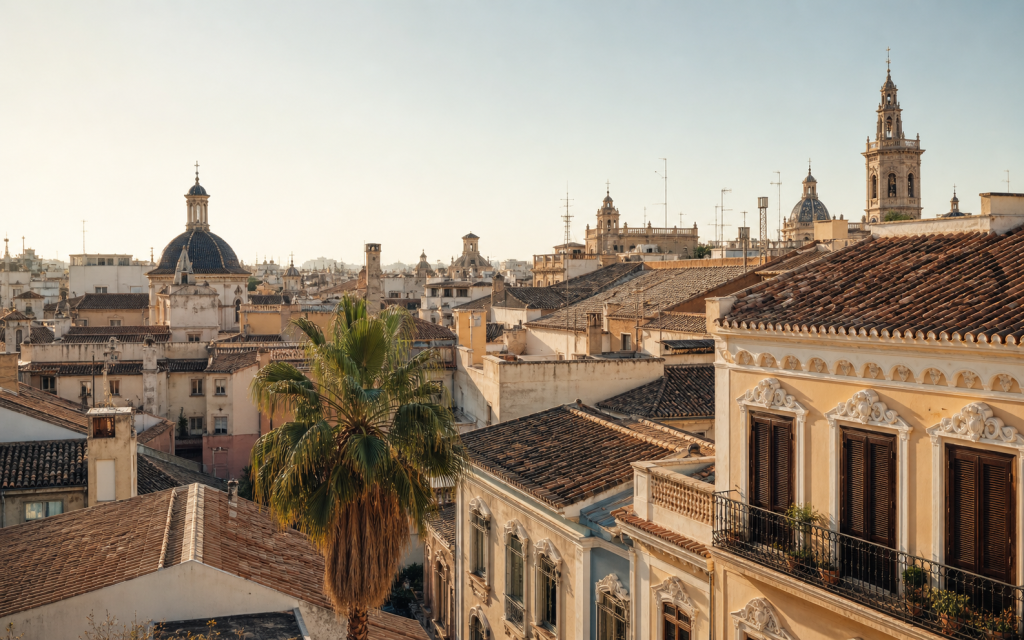
Most “best neighborhoods in Valencia” articles are written by people who do not have to live with the recommendation. This one is. We work with international buyers full-time, in the same six districts year after year. What follows is the short list — the parts of Valencia worth a buyer’s serious attention in 2026, and a few honestly noted areas we tend to steer clients away from.
How we think about Valencia neighborhoods
Valencia has nineteen administrative districts and roughly seventy named barrios. For an international buyer, that level of granularity is not useful. What matters is whether the neighborhood you choose actually fits how you intend to live, and whether the property holds its value through the next economic cycle.
We assess each area on four dimensions:
- Daily livability — walkability, noise, density, the texture of an ordinary Tuesday.
- Building stock — what you can actually buy. Period building with high ceilings, 1970s tower, off-plan, restored finca. Each carries different costs and risks.
- Pricing trajectory — current €/m² versus three-year trend, and whether prices are driven by foreign demand, local upgrade cycles, or speculation.
- Buyer fit — quiet retiree, urban couple, young family, second-home owner, lifestyle buyer. The same neighborhood is a good or bad answer depending on who is asking.
What follows is six neighborhoods that matter, written in the order an international buyer typically encounters them.
Ruzafa — central, alive, sometimes too alive
Ruzafa (Russafa, in Valenciano) is the cultural centre of gravity in central Valencia. South of the railway, north of the Gran Vía, walkable to everything. Specialty coffee, independent galleries, late dinners, a Saturday market that genuinely sells produce people cook with. It is the most-discussed neighborhood among foreign buyers, and it earns the attention.
The building stock is mostly early 20th-century apartments — high ceilings, mosaic floors, central courtyards, four to six floors, lifts retrofitted unevenly. A renovated three-bedroom with light on two sides is genuinely a beautiful place to live.
Indicative pricing (resale, renovated): roughly €3,500–€4,500 per m². Original-condition flats start lower but renovation in central Valencia rarely costs less than €1,200/m² done properly.
Where buyers go wrong: they buy on charm and discover the noise. Calle Cuba and Calle Cádiz are loud most nights. The internal corridor flats — second floor, courtyard-facing — are quieter but darker. Always view a Ruzafa flat at 11pm on a Friday before signing.
Best fit: urban couples, second-home owners who want walkability, food-and-culture buyers. Less ideal for retirees who need quiet, or families with school-age kids (the schools that suit international families are not in Ruzafa).
Pla del Real and Mestalla — quiet, refined, central
If Ruzafa is the loud answer, Pla del Real is the quiet one. Bordered by the dry Turia gardens, Avenida Aragón and the old Mestalla stadium grounds, this is one of the most consistently liveable parts of central Valencia. It is also where reSELECTA’s office is — not a coincidence.
The building stock is more mixed than Ruzafa: solid 1960s–1980s residential blocks, a thinner layer of period buildings, and a meaningful amount of recent new-build along Avenida Aragón. Apartments tend to be larger, with three to four bedrooms common, and many buildings have garages — rare in the older centre.
Indicative pricing: €3,000–€4,200 per m² for resale, higher for new-build along the avenue.
Why it works for international buyers: walkable to the Turia park (eight kilometres of green linear park down the old riverbed — Valencia’s best amenity), close to the central business district without the noise, and within reach of Cabanyal beach by bicycle in twenty minutes.
Best fit: retirees, families with children at international schools (Cambridge House, Caxton College and similar are accessible by car), urban couples who want central life without the bar density of Ruzafa.
Ciutat Vella — the historic Old Town
Ciutat Vella is the old walled city: El Carmen, La Seu, Sant Francesc, Mercat, Xerea. Cobblestone streets, palaces converted into apartments, the Cathedral, the Lonja, the Mercado Central. It is the Valencia tourists photograph and the part of the city most prone to romanticization at the moment of purchase.
The reality is more textured. El Carmen has a serious nighttime tourism load and genuine quality-of-life issues with short-term rentals on certain streets. La Seu and Sant Francesc are quieter and arguably the most beautiful streets in the city. Xerea, on the eastern edge, is the most residential pocket of the old town.
Indicative pricing: €3,200–€4,800 per m², with high variance. A renovated palace floor with frescoed ceilings and a private terrace can clear €6,000/m². An unrenovated walk-up on a busy street can be much lower.
What to scrutinize: structural condition (some buildings are 18th-century and have not been touched seriously in decades), short-term rental activity in the building, and the regulatory direction of municipal STR policy — which has tightened repeatedly and will likely tighten again.
Best fit: buyers who actively want to live with history and accept its compromises. Not a good fit for anyone whose first priority is convenience, parking, or quiet.
El Cabanyal and Canyamelar — beachfront, in active transition
Cabanyal is a former fishing district that runs along the city’s main beach (Playa de la Malvarrosa). For decades it was neglected by municipal policy and physically decaying. Over the last ten years, partly by gentrification and partly by deliberate restoration, large parts of it have become genuinely attractive — rows of single-storey period houses with tiled façades, low-rise scale, the sea three streets away.
This is the most price-sensitive of the central options. Pricing is heterogeneous: the restored streets near Calle Doctor Lluch and Calle de la Reina sit at one level, while two streets inland the same square metre is meaningfully cheaper. We recommend Cabanyal often, but always with a careful look at the specific block.
Indicative pricing: €2,400–€3,800 per m², with strong variation by block. Restored single-family houses (very rare elsewhere in Valencia) trade between €450k and €900k depending on size and condition.
What to know: the gentrification debate is real and ongoing, the train tracks at the back of the neighborhood remain a barrier, and parking is harder than the centre. The beach, however, is a five-minute walk and the area has held its growth trajectory through the last cycle.
Best fit: lifestyle buyers, beach-first buyers, anyone wanting a single-family townhouse close to a city centre at a reasonable price.
Patacona and Alboraya — modern beachfront living
Just north of Cabanyal, across the administrative line, lies Patacona — technically part of Alboraya, technically not Valencia city, in practice continuous with it. The building stock here is almost entirely 1990s–2020s mid-rise on a regular grid, three blocks from a wide sandy beach, with cycle lanes connecting back to the centre.
This is the answer for a buyer who wants beachfront, modernity, parking, and family-grade amenities without the historical complications of Cabanyal or the noise of central Valencia. It is also, by a meaningful margin, where the most international buyers from Northern Europe end up settling.
Indicative pricing: €2,800–€4,200 per m², with new-build promotions toward the upper end and front-line beach apartments commanding a premium.
What to know: in summer the beachfront strip is busy. Schools in Alboraya are good and there is a strong international community. The downside is that you will use a car or scooter to access central Valencia daily — bicycle is possible but not always practical.
Best fit: families relocating with children, second-home buyers from Northern Europe, retirees who want a beach lifestyle in a structured modern environment.
Benimaclet — value play, currently shifting
Benimaclet sits between the Turia park and the airport-side of the city — a former village now absorbed into Valencia, partly student neighborhood, partly creative quarter, with a distinct village core and a low-key food scene that has been quietly consolidating.
The pricing here is the most accessible of the six neighborhoods we recommend. The building stock is mixed and uneven — some blocks are tired, others are interesting period stock, and a few new-build projects are coming online. The metro to the centre takes ten minutes.
Indicative pricing: €2,200–€3,200 per m². The cheapest entry point into Valencia where we still think a buyer is making a decent decision.
The trajectory question: Benimaclet has been “the next Ruzafa” in foreign-buyer chatter for years. We are cautious about the framing — Ruzafa’s transformation took fifteen years and a specific commercial mix. Benimaclet is shifting, not flipping. Buy it because you want to live there now, not because you expect 2018 Ruzafa returns.
Best fit: first-time international buyers on a tighter budget, creatives, anyone who values community feel over centrality.
Areas we usually steer clients away from
This list is the half of the conversation that no one writes down, but it matters more.
- South of the river outskirts (Patraix, Vara de Quart, parts of Jesús) — primarily residential local neighborhoods. Nothing wrong with them. They simply do not match what an international buyer is usually looking for in Valencia: walkability to the centre, character, or beach access.
- Algirós and parts of Camins al Grau — uneven building stock, mixed areas next to better ones. Possible to buy well here, but it requires real local knowledge of which block. Generally a poor area to buy into without it.
- Tourist-saturated streets in Ciutat Vella — even within the Old Town, certain streets are at the limit of liveability for owner-occupiers. We name them privately for clients but the test is simple: walk it on a Saturday at midnight.
- Off-plan complexes far from the city core marketed primarily to foreign buyers — usually overpriced, underwhelmingly built, and difficult to resell. The presence of multilingual sales offices is not a quality signal.
None of this is meant to be dismissive. Valencia is a large, complex city with genuinely good corners that we have not listed. But for an international buyer with a six-to-twelve-week purchase window, the six neighborhoods above are almost always the right place to focus.
Match your profile to a neighborhood
| If you are… | Look first at |
|---|---|
| A retiree who values quiet and walkability | Pla del Real, Patacona |
| A young couple, urban culture-driven | Ruzafa, Ciutat Vella (eastern edge) |
| A family relocating with school-age children | Pla del Real, Patacona, Alboraya |
| A beach-first lifestyle buyer | Cabanyal, Patacona |
| A second-home owner, urban use 2–3 months/year | Ruzafa, Pla del Real, Ciutat Vella |
| A buyer prioritising long-term value at lower entry price | Cabanyal (selectively), Benimaclet |
This table is a starting point, not a verdict. Two buyers with the same profile often choose different neighborhoods because of factors a matrix cannot capture — light orientation, building character, the specific block, the specific neighbour upstairs.
Where to start
If you are early in your Valencia research, two practical next steps:
- Read the costs side first. Neighborhood is one variable; total cost of ownership is another. Our full guide to buying property in Spain as a foreigner walks through fees, taxes, and the buyer process end to end. The purchase costs calculator gives you a quick number for any specific property.
- Walk the shortlist before you fly back. The single most useful thing any international buyer can do in Valencia is spend a weekend walking three or four of these neighborhoods at different times of day. We run a structured one-day version of this for clients — see the Strategy Session and Preview Trip on our services page.
If you would like a private read on which of these neighborhoods fits your specific profile and budget, that conversation is what we exist to have. Get in touch.