
Annual Cost of Owning Property in Spain (2026): IBI, Community Fees, Non-Resident Tax
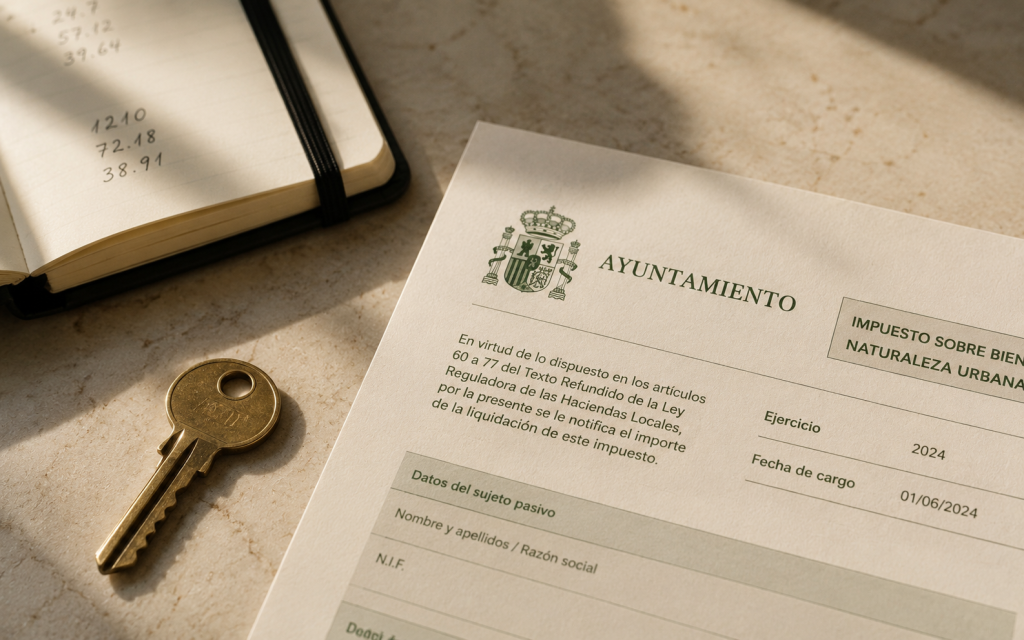


Holding property in Spain costs roughly 0.5–1.0% of the purchase price per year for a typical foreign owner. For a €450,000 apartment in Valencia, that’s around €2,500 annually. For an €800,000 villa on the Costa Blanca, around €5,500. The five recurring lines are IBI (municipal property tax), basura (waste collection), community fees, non-resident income tax filed via Modelo 210, and home insurance. Below is the line-by-line 2026 breakdown with three worked examples.
The headline number
If you’ve already read our cost-of-buying breakdown, you know the one-off bill at the notary’s table is about 11–13% on top of the purchase price. What that article doesn’t cover is what comes after — what it costs to hold the property year after year.
The answer is reassuringly modest by international standards. As a rule of thumb:
- Apartment in Valencia city, €350K–€600K: €2,000–€3,500/year
- Townhouse on the Costa Blanca, €400K–€700K: €2,500–€4,500/year
- Villa with pool in a premium urbanización, €800K–€1.5M: €5,000–€10,000/year
- Anything rented out short-term: add the rental income tax — often the biggest line
Spain has no annual property tax like the US or UK council tax model. Instead there are several smaller lines, paid to different authorities at different times. Here’s each one.
IBI — the municipal property tax
IBI (Impuesto sobre Bienes Inmuebles) is the Spanish equivalent of council tax. Every owner of property in Spain pays it, regardless of residency or nationality. It is set and collected by the municipality (ayuntamiento) where the property is located.
How IBI is calculated
IBI is a percentage of the property’s cadastral value (valor catastral) — an administrative value set by the Catastro, not the market value. Critically, cadastral value is typically 30–50% of market value, sometimes lower for older properties. So a €500,000 home might have a cadastral value of €150,000–€250,000.
The municipality applies an annual rate — set within the legal range of 0.4–1.1% for urban properties — to that cadastral value.
2026 IBI rates by municipality
| Municipality | IBI rate (urban) |
|---|---|
| Valencia city | 0.654% |
| Altea | 0.85% |
| Jávea / Xàbia | 0.81% |
| Dénia | 0.79% |
| Calpe | 0.66% |
| Madrid | 0.456% |
| Barcelona | 0.75% |
| Marbella | 0.84% |
Rates are reset by each municipality during the annual ordenanzas fiscales cycle (typically late autumn). Variations of a few basis points year to year are normal.
When and how IBI is paid
Each municipality sets its own payment window — usually a single annual bill due between July and November, or split into two instalments. In Valencia city, IBI is billed around September–October. In Alicante province, IBI for most municipalities is collected through SUMA (the provincial collection agency), which consolidates IBI, basura, vado, and several other municipal items into one or two annual bills.
You can pay IBI by direct debit (recommended — set this up once and forget it), at participating banks, or online through the municipality’s or SUMA’s portal. Late payment triggers surcharges, and unpaid IBI eventually attaches as a real-estate lien.
Typical IBI in numbers
- €350K apartment in Valencia city, cadastral value ~€90K → IBI ~€590/year
- €500K townhouse in Jávea, cadastral value ~€140K → IBI ~€1,135/year
- €800K villa in Altea, cadastral value ~€200K → IBI ~€1,700/year
- €1.5M villa in a premium urbanización, cadastral value ~€450K → IBI ~€3,825/year
Basura — waste collection
The waste tax (tasa de recogida de basuras) is a small annual fee paid to the municipality for refuse collection. It is independent of IBI in most municipalities, though in some (especially through SUMA in Alicante province) it appears on the same bill.
Typical amounts in our coverage area:
- Valencia city: €100–€140/year
- Costa Blanca municipalities (Altea, Jávea, Calpe, Dénia): €130–€220/year
- Premium urbanizaciones with separate private collection: sometimes folded into community fees
From 2025 onwards, several Spanish municipalities have begun restructuring basura under the new EU-aligned waste regulations (Ley 7/2022). Some have shifted to a “pay-as-you-throw” model. In practice, the absolute amount stays modest — but expect billing detail to change.
Community fees — what you pay for shared infrastructure
If your property is part of a comunidad de propietarios — almost always the case for apartments, townhouses in urbanizaciones, and any property with shared pools, gardens, lifts, or security — you pay monthly community fees.
Community fees cover: shared cleaning, lift maintenance, pool and garden upkeep, common-area electricity and water, building insurance, doorman or concierge salaries, security, and a reserve fund (fondo de reserva) for major works. They do not cover your private utilities (electricity, gas, internet — those are your own contracts).
Community fee ranges
| Property type | Monthly fee | Annual |
|---|---|---|
| Standard apartment, no lift, no pool | €30–€70 | €360–€840 |
| Apartment with lift + small communal terrace | €70–€130 | €840–€1,560 |
| Apartment in a premium block with pool, garden, concierge | €150–€300 | €1,800–€3,600 |
| Townhouse in a Costa Blanca urbanización with pool | €100–€220 | €1,200–€2,640 |
| Villa in a premium gated urbanización (security, multiple pools, sports facilities) | €250–€600 | €3,000–€7,200 |
| Standalone villa, no community | €0 | €0 |
Premium developments along the Costa Blanca — Sierra Altea, Altea Hills, Cumbre del Sol, La Sella in Dénia, certain enclaves in Jávea — sit at the upper end of this scale because they include private security, multiple pools, gardening of large landscaped grounds, and sometimes private roads.
What to check before you buy
- Outstanding debts: in Spain, unpaid community fees can attach to the property for the current year and the previous three. A good lawyer will request a certificado de deudas con la comunidad before signing.
- Reserve fund health: ask for the last two annual community accounts. A community with no reserve is one major repair away from a derrama (special assessment).
- Pending works: any scheduled façade work, lift replacement, or roof renewal will be billed via derrama. Confirm what’s voted in.
Non-resident tax — Modelo 210
This is the line foreign owners forget most often. If you own property in Spain but are not a Spanish tax resident, you owe Impuesto sobre la Renta de no Residentes (IRNR), filed annually (or quarterly, if rented) via Modelo 210.
There are two scenarios — and the tax behaves very differently in each.
Scenario 1 — Property not rented (imputed income)
Even if you don’t rent the property and use it only yourself, Spain assumes a small “imputed” income for your personal use, and taxes you on that imputed amount.
The imputed base is:
- 1.1% of cadastral value if the cadastral value was revised in the last 10 years
- 2.0% of cadastral value if it was not
The tax rate applied to that base is:
- 19% for residents of the EU, EEA, Norway, or Iceland
- 24% for everyone else — including UK residents (post-Brexit), US, Canada, Australia, Switzerland, UAE, China, Russia
Filing is annual, due by 31 December of the year following the tax year. For most owners, the amounts are modest — €200–€800/year is typical for an apartment, €500–€1,500 for a villa.
Scenario 2 — Property rented out
If you rent the property (long-term or vacation rental), you pay tax on the actual rental income:
- EU/EEA residents: 19% on net rental income (after legitimate expenses — mortgage interest, IBI, community fees, depreciation, maintenance, agency fees, insurance, all properly invoiced)
- Non-EU residents (UK, US, etc.): 24% on gross rental income — no expense deductions allowed
For UK owners post-Brexit, this is the single biggest change since 2021. A property that was paying 19% on €5,000 net income (~€950 tax) under EU rules now pays 24% on €15,000 gross income (~€3,600 tax). The same property, the same rental, suddenly costs ~€2,650 more per year in tax.
Rental filings are quarterly, due in the 20 days following each quarter-end (January, April, July, October).
Who files Modelo 210
You can file it yourself through the Agencia Tributaria’s online portal — but it’s bilingual Spanish/English and assumes you understand IRNR mechanics. In practice, almost every foreign owner uses a Spanish gestor or tax advisor for this. Typical fees:
- Annual Modelo 210 for imputed income (non-rented): €80–€150
- Quarterly Modelo 210 for rental income: €300–€500/year total
- One-off Modelo 210 to declare a sale capital gain: €200–€400
This is the single most common late-discovered cost. Owners skip Modelo 210 for years thinking it doesn’t apply — and then discover it when they try to sell. The tax authority has up to four years to claim back unpaid IRNR with surcharges.
Home insurance
Spanish home insurance (seguro de hogar) is mandatory if you have a mortgage — banks require at least continente cover (the structure itself) and usually content cover too. Without a mortgage, it is not legally required but strongly recommended.
Typical 2026 premiums:
- Apartment in Valencia city, €350K, basic continente + contenido: €220–€350/year
- Townhouse on the Costa Blanca, €500K: €350–€550/year
- Villa with pool, €800K–€1.5M: €600–€1,200/year
One quiet detail: the insurance bundled by your mortgage bank is almost always more expensive than the same cover sold independently. Banks bundle home insurance with mortgage offers because it improves their margin, not because it’s a better product. If your bank waived the mortgage arrangement fee in exchange for taking their home insurance, recheck after year 1 and switch to an independent insurer when allowed (typically after the first annual cycle).
Wealth tax — does it apply to you?
Spain levies a wealth tax (Impuesto sobre el Patrimonio) on high-value holdings, with thresholds and bonifications set regionally. For most foreign buyers of homes under €800K–€1M, the practical liability is zero. For high-value villas and multi-property portfolios, it deserves a conversation with a tax advisor before purchase.
The headline rules for property in the Comunidad Valenciana (covers both Valencia city and the entire Costa Blanca):
- Threshold: €500,000 of net Spanish assets per person (€1M for a couple holding jointly)
- Main-home exemption: up to €300,000 of the value of your primary residence (only for tax residents)
- Brackets: progressive, from 0.25% to 3.5% on the slice above threshold
- Bonification: the Comunidad Valenciana applies its own regional rate; reforms are revised annually
Layered on top, there is a national Impuesto de Solidaridad de las Grandes Fortunas targeting net assets above €3M, designed to capture taxpayers whose regions bonificate wealth tax to zero. For most second-home buyers below ~€2M total Spanish net wealth, this is not in scope.
Wealth tax is calculated on cadastral value or purchase price or reference value — whichever is highest. This is the detail that turns a comfortable €800K villa into a wealth-tax case for some structures. Worth one hour with a tax advisor before signing — not after.
Utilities and operating costs
These aren’t taxes, but they are unavoidable, and people often forget the standing charges. Even an empty apartment generates monthly bills.
- Electricity (luz): standing charge €15–€30/month + consumption. Empty apartment ~€20/month total.
- Water (agua): standing charge €10–€20/month + consumption. Empty apartment ~€15/month.
- Gas (gas): only if connected; €10–€20/month standing.
- Internet/fibre: €30–€50/month if you keep it active year-round.
For a property left empty most of the year, plan €600–€1,200/year in utility standing charges and minimal consumption.
Three worked examples
All figures are 2026 estimates rounded to the nearest €10. Cadastral values are approximate — your actual cadastral can be checked on the Catastro portal with the property reference.
Example 1 — €450K apartment in Valencia city, EU owner, not rented
| Property type | Apartment, Eixample area, with lift |
| Cadastral value (approx.) | €110,000 |
| IBI (0.654%) | ~€720 |
| Basura | ~€110 |
| Community fees (€100/mo) | ~€1,200 |
| Modelo 210 imputed (1.1% × 19%) | ~€230 |
| Home insurance | ~€300 |
| Gestor (annual Modelo 210) | ~€100 |
| Total annual cost | ~€2,660 (≈0.59% of price) |
Example 2 — €800K villa in Altea, non-EU owner (UK/US), not rented
| Property type | Villa with pool, premium urbanización |
| Cadastral value (approx.) | €200,000 |
| IBI (0.85%) | ~€1,700 |
| Basura (via SUMA) | ~€180 |
| Community fees (€200/mo) | ~€2,400 |
| Modelo 210 imputed (1.1% × 24%) | ~€530 |
| Home insurance | ~€700 |
| Gestor (annual Modelo 210) | ~€120 |
| Total annual cost | ~€5,630 (≈0.70% of price) |
Example 3 — €350K apartment in Jávea, non-EU owner (UK), short-term rented
| Property type | Apartment near the marina, tourist licence |
| Cadastral value (approx.) | €85,000 |
| Rental income (gross) | €15,000 |
| IBI (0.81%) | ~€690 |
| Basura | ~€150 |
| Community fees (€90/mo) | ~€1,080 |
| Modelo 210 (24% on €15K gross — no deductions) | ~€3,600 |
| Home insurance (rental cover) | ~€450 |
| Gestor (quarterly Modelo 210) | ~€400 |
| Total annual cost | ~€6,370 (≈1.82% of price) |
Example 3 is the case where Brexit math really lands. The same property held by an EU owner — paying 19% on net €5,000 after deductions — would owe ~€950 in rental tax instead of €3,600. That’s a €2,650 swing per year on the same asset.
Costs that are not annual — and people confuse them
To avoid double-counting, a quick note on what does not show up in this annual list:
- Plusvalía Municipal: a municipal tax on the increase in cadastral land value, paid only on sale or inheritance — by the seller, not the buyer. Not annual.
- ITP, IVA, AJD: one-off transfer taxes paid at purchase. See our cost-of-buying breakdown.
- Capital gains tax: paid only when you sell at a profit. For non-residents, withholding of 3% of sale price at signing, then reconciliation via Modelo 210 on the actual gain (19% EU / 24% non-EU).
- Inheritance tax (Impuesto de Sucesiones): only at death of the owner. Regionally bonified — in the Comunidad Valenciana, 99% bonification applies to spouses and children, so practical liability is very low.
Rule of thumb for budgeting
For straightforward planning before purchase, use these multipliers on the asking price:
- Apartment, EU owner, not rented: 0.55–0.70% of price per year
- Apartment, non-EU owner, not rented: 0.60–0.75% of price per year
- Villa with pool in premium urbanización, EU: 0.65–0.85% of price per year
- Villa with pool in premium urbanización, non-EU: 0.70–0.95% of price per year
- Anything rented short-term, non-EU: add another 1.0–1.5% of price per year for rental income tax
For a more precise number before you commit to a specific property, ask for the seller’s most recent IBI bill and community-fee statement — both are documents the seller is obliged to produce. Add an estimate for Modelo 210 and insurance based on your residency.
Common mistakes that inflate the real cost
- Skipping Modelo 210 for years. Discovered when selling, with surcharges of 5–20% plus interest. Set up the annual filing the first year of ownership and forget it.
- Buying into a community with no reserve fund. One major repair turns into a €5,000–€20,000 derrama that lands with no warning.
- Taking the bank’s bundled home insurance and never re-shopping. The first year is locked in. The years after are not.
- Underestimating the Brexit rental tax. UK owners moving to a 24%-on-gross rate often realise rental yields no longer pencil out.
- Direct-debit problems. If your Spanish account runs low and the IBI direct debit bounces, the municipality adds a surcharge and can eventually publish you in the BOE registry of debtors.
- Assuming Valencia has no wealth tax. The regional bonification has shifted in recent years — confirm with a tax advisor in the year of purchase, especially above €1M Spanish net wealth.
How a boutique advisor saves money here
Once you own, the bills land regardless. The work happens before you sign: a clean community with a healthy reserve fund, a building with no pending derrama, a property where cadastral value is realistically structured, a residency and rental plan that fits the tax regime you actually want to be in. That’s where the difference between a €2,500/year holding cost and a €6,500/year one is decided — not at the IBI bill.
That is the work we do. Selective by design: we represent the buyer, not the listing.
FAQ
How much does it cost annually to own property in Spain?
For a typical foreign owner, plan 0.5–1.0% of the purchase price per year. A €450,000 apartment in Valencia costs around €2,500/year to hold. An €800,000 villa on the Costa Blanca costs around €5,500/year. Properties rented out short-term cost considerably more in tax — especially for non-EU owners.
What is IBI tax in Spain?
IBI (Impuesto sobre Bienes Inmuebles) is the Spanish municipal property tax, the equivalent of council tax. It is 0.4–1.1% of the cadastral value of the property, set annually by each municipality. Valencia city sits at 0.654%, Altea at 0.85%, Madrid at 0.456%. IBI is paid by the owner regardless of nationality or residency.
Do I pay tax in Spain if I don’t rent the property?
Yes. Non-resident owners pay an annual imputed-income tax via Modelo 210 — 19% (EU/EEA) or 24% (non-EU including UK and US) on 1.1% of the cadastral value. For an apartment with €100K cadastral, that’s around €210–€265 per year. Modest, but mandatory.
What is Modelo 210?
Modelo 210 is the Spanish tax form for non-resident income tax (IRNR). Non-resident property owners file it annually if the property is not rented (imputed income), or quarterly if it is. Most owners use a Spanish gestor — typical cost €80–€150/year for non-rented, €300–€500/year for rentals.
Do UK owners pay more tax than EU owners in Spain?
Yes, since Brexit. UK residents are taxed at 24% (instead of 19%) and cannot deduct expenses from rental income — 24% applies to gross rent. For a property earning €15,000/year gross, a UK owner pays around €3,600 in rental tax, versus around €950 for an equivalent EU owner with deductions. This single change has materially shifted the math on UK-owned holiday lets.
When is IBI paid in Spain?
Each municipality sets its own window — most issue the bill between July and November. In Alicante province, IBI is collected through SUMA, consolidated with basura and other municipal taxes onto one or two annual bills. The simplest setup is direct debit from a Spanish bank account.
Are community fees in Spain negotiable?
No. Community fees are set by the community of owners (the comunidad) at the annual general meeting, voted by majority based on each unit’s participation quota (cuota de participación). You can vote at the meeting, but you cannot opt out. Before buying, always ask for the community’s last two annual accounts and a debts certificate.
How much does home insurance cost in Spain?
A standard apartment in Valencia city, €350K, costs around €220–€350/year for continente + contenido cover. A €500K Costa Blanca townhouse: €350–€550/year. An €800K–€1.5M villa with pool: €600–€1,200/year. Bank-bundled insurance via your mortgage is usually 20–40% more expensive than the same cover sold independently.
Is there wealth tax on property in Valencia?
The Comunidad Valenciana applies its own regional schedule with a €500,000 threshold per person and progressive brackets above. A €300,000 main-home exemption applies for tax residents. For most second-home buyers below €1M Spanish net wealth, practical liability is modest or zero. Above ~€2M, the national Solidarity Tax on Large Fortunes can also apply. Worth one hour with a tax advisor before purchase.
What annual costs does the seller hide from buyers?
Three common omissions: unpaid IBI carried over from prior years (which can attach as a lien), pending derramas voted in by the community but not yet billed, and a community reserve fund so depleted that the next major repair will be a special assessment. A careful lawyer will request the IBI receipts, community accounts, and a debts certificate before signing.
Sources and further reading
For underlying tax and legal references — useful for cross-checking with your own advisor:
- Agencia Tributaria — Modelo 210 forms, IRNR rules, official non-resident tax guidance
- Catastro — cadastral value lookup, basis for IBI and imputed income
- SUMA Gestión Tributaria — IBI and municipal tax collection for Alicante province / Costa Blanca
- Generalitat Valenciana — Hisenda — Comunidad Valenciana tax rules, wealth tax bonifications
- Ley 7/2022 (BOE) — waste management framework affecting basura billing reform
Where to start
If you are 6–12 months out from a purchase, building a realistic ownership budget into your decision early is one of the highest-leverage things you can do. It changes the price range you should be looking at, and it changes which structures make sense (personal name vs. company, EU residency vs. non-EU, rented vs. used personally).
Read the full cost-of-buying breakdown · Read the Spanish mortgages guide · Compare NLV and Digital Nomad Visa · Get in touch.