
How Much Does It Really Cost to Buy Property in Spain? (2026)
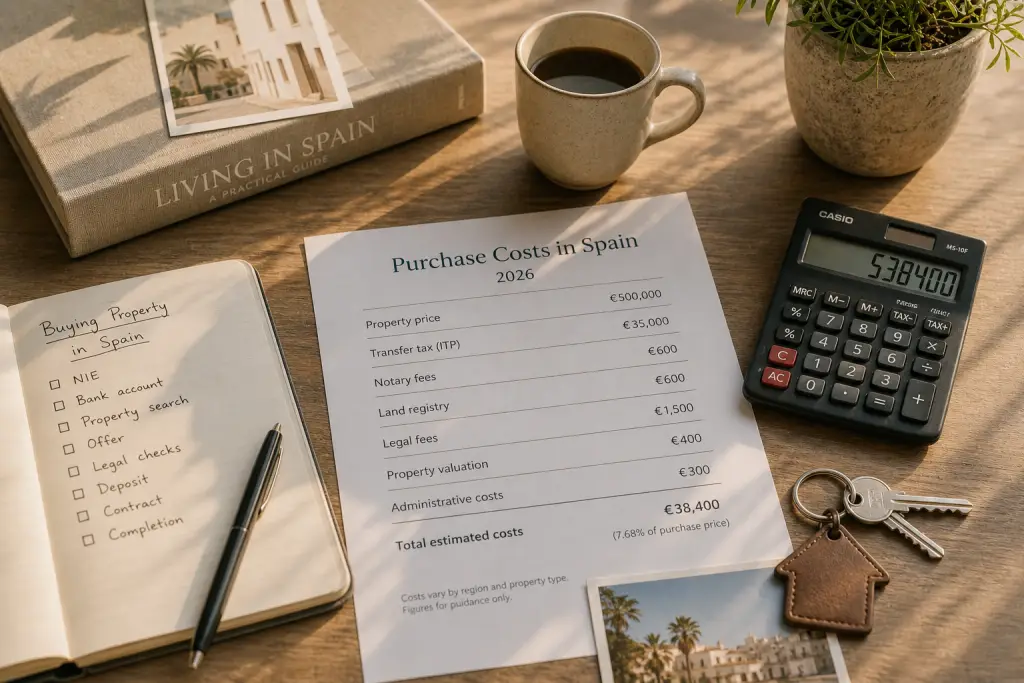

Buying a resale property in Spain costs roughly 11–13% on top of the asking price. A new build costs 12–15% on top. The single biggest line item is regional transfer tax — everything else (notary, registry, legal) usually adds up to around 1.5–2% combined. Below is the line-by-line 2026 breakdown, with three worked examples for Valencia and Costa Blanca.
The headline number
Most international buyers underestimate the closing costs in Spain. The price you see on Idealista or in a brochure is not what you pay. You should plan for one of two scenarios:
- Resale property: add ~11–13% to the asking price.
- New build (off-plan or first transmission from developer): add ~12–15%.
If you are financing with a Spanish mortgage, the cash you actually need to deposit at signing is roughly: down payment (30–40% of price) + closing costs (~12% of price). For a €500,000 property that means around €210,000–€260,000 in cash. We walk through three full examples further down.
Transfer tax — the biggest line
This is where most of the cost sits, and it depends entirely on (a) whether the property is resale or new build, and (b) which Spanish region (comunidad autónoma) you buy in.
Resale: ITP (Impuesto de Transmisiones Patrimoniales)
ITP is a one-off tax paid by the buyer on a second-hand property. It is set regionally. Approximate 2026 rates for the regions our clients ask about most:
| Region | ITP rate (resale) |
|---|---|
| Valencia (Comunidad Valenciana) | 10% |
| Madrid | 6% |
| Andalucía | 7% |
| Catalonia | 10% (11% on the portion above €1M) |
| Murcia | 8% |
| Balearic Islands | Progressive 8–13% |
Both Valencia city and the Costa Blanca (Alicante province) sit inside the Comunidad Valenciana, so the same 10% applies across our entire coverage area.
One detail that catches people out: the tax is calculated on whichever is higher between the declared purchase price and the regional valor de referencia (a reference value set by the Catastro). If your agreed price is below the reference value, you pay tax on the reference value. A serious buyer’s lawyer always checks this before signing.
New build: IVA + AJD
If you buy directly from a developer (first transmission), you pay IVA (Spanish VAT) instead of ITP, plus a stamp duty called AJD:
- IVA: 10% on residential property (21% on commercial / land).
- AJD (Actos Jurídicos Documentados): set regionally, typically 1.2–1.5%. Valencia: 1.5%. Madrid: 0.75%. Andalucía: 1.2%.
So a new-build apartment in Valencia city is taxed at 10% + 1.5% = 11.5% of price, before any other costs.
Notary, Registry, Gestoría
These are fixed-tariff costs and don’t vary much. Together they typically add up to 1.0–1.5% of the price.
Notary (Notario)
The escritura pública (public deed) must be signed in front of a Spanish notary. Notary fees are regulated by national tariff and scale with the price. Expect:
- €600–900 for a property up to €400,000
- €900–1,300 for €400,000–€800,000
- €1,300–2,000 for €800,000–€1,500,000
Land Registry (Registro de la Propiedad)
To register the property in your name. Also tariff-based:
- €400–700 for most residential transactions
- €800–1,200 for higher-value properties
Gestoría
An administrative agent who handles tax filings, registry submission, and the paperwork chain. Typically €300–600. Some lawyers fold this into their fee.
Legal fees
You should always use an independent Spanish-qualified lawyer (abogado) — not the seller’s lawyer, not the agency’s lawyer, not “the developer’s lawyer is fine.” Standard market rates:
- 1% of the purchase price + 21% IVA on that fee — most common structure
- Or a fixed fee of €2,000–€4,000 for straightforward resale transactions
- Premium / complex cases (corporate buyer, structuring, due diligence on rural land, urbanistic issues): €5,000–€15,000+
Cheaper than this is a red flag, not a deal. The lawyer is what protects you from buying a property with debts attached, an unregistered extension, planning irregularities, or a wrong-name title.
NIE and Power of Attorney
You cannot buy property in Spain without a NIE (Número de Identificación de Extranjero). Two routes:
- Apply at a Spanish consulate in your home country: small administrative fee, no flight needed. Often a 4–8 week wait.
- Apply in Spain in person: faster if you book the right slot, ~€10 official fee.
- Power of Attorney (POA): if you can’t be in Spain for the signing, your lawyer can sign on your behalf. Notary cost ~€60–150, plus translation if the POA is granted abroad. Plan ~€200–400 total.
Mortgage costs (if financing)
The 2019 Spanish mortgage law (Ley 5/2019) shifted most mortgage-related costs to the bank. As a buyer you now typically only pay:
- Property valuation (tasación): €300–600. Required by the bank, paid by you.
- Mortgage arrangement fee: 0–1% of loan amount. Many banks waive this in exchange for product cross-sell (life insurance, home insurance, salary domiciliation).
For non-resident buyers, banks typically lend 60–70% LTV (loan-to-value), so plan for 30–40% down payment plus the closing costs in cash.
Three worked examples
Real numbers, rounded to the nearest €100. All three assume cash purchase. With a mortgage you would add tasación and (potentially) an arrangement fee on top.
Example 1 — €350,000 resale apartment in Valencia city
| Asking price | €350,000 |
| ITP (10%) | €35,000 |
| Notary | ~€800 |
| Land Registry | ~€500 |
| Gestoría | ~€400 |
| Legal (1% + 21% IVA) | ~€4,200 |
| Total extra costs | ~€40,900 (≈11.7%) |
| Total cash needed | ~€390,900 |
Example 2 — €600,000 new build on the Costa Blanca
| Asking price (developer) | €600,000 |
| IVA (10%) | €60,000 |
| AJD (1.5%) | €9,000 |
| Notary | ~€1,100 |
| Land Registry | ~€700 |
| Gestoría | ~€450 |
| Legal (1% + 21% IVA) | ~€7,300 |
| Total extra costs | ~€78,500 (≈13.1%) |
| Total cash needed | ~€678,500 |
Example 3 — €1,200,000 villa in Altea (resale)
| Asking price | €1,200,000 |
| ITP (10%) | €120,000 |
| Notary | ~€1,800 |
| Land Registry | ~€1,200 |
| Gestoría | ~€500 |
| Legal (1% + 21% IVA) | ~€14,500 |
| Total extra costs | ~€138,000 (≈11.5%) |
| Total cash needed | ~€1,338,000 |
For deeper area-by-area pricing, see our Valencia neighbourhood guide and Costa Blanca guide.
Recurring costs after you own
One-off costs end at the notary’s table. Ownership costs continue annually:
- IBI (Impuesto sobre Bienes Inmuebles): the Spanish equivalent of council tax / property tax. 0.4–1.1% of the cadastral value (which is typically 30–50% of market value, not market value itself). For a €500K market-value home, IBI is often €400–€1,200/year.
- Basura (rubbish collection): €100–€300/year, billed by the local council.
- Comunidad (HOA / community fees): for apartments and gated developments. Ranges from €30/month for a basic block to €300+/month for a building with concierge, pool, and gardens.
- Non-resident income tax (IRNR): if you don’t live in Spain but own property here, you pay an annual imputed rental tax — 19% (EU/EEA residents) or 24% (non-EU, including UK and US) on 1.1% of cadastral value. Modest in absolute terms but mandatory.
- Wealth tax (Impuesto sobre el Patrimonio): in Valencia, the threshold is €500,000 of net Spanish assets per person, with a €300,000 main-home exemption. Brackets are progressive. Most second-home buyers below ~€700K market value won’t trigger meaningful liability — but high-value villas can. Worth a one-hour conversation with a tax advisor before purchase.
Costs paid by the seller (don’t let them get pushed to you)
Two costs legally belong to the seller:
- Plusvalía Municipal: a municipal tax on the increase in cadastral land value during the seller’s ownership.
- Estate agent commission: typically 3–5% + IVA, paid by the seller.
In some negotiations, sellers try to push plusvalía onto the buyer “as is the local custom.” It is not. A good buyer’s representative will keep these where they belong.
Common mistakes that inflate the real cost
- Underestimating the closing-cost line. Buyers calibrated to the UK or US market often budget 3–5% on top. In Spain it is roughly triple that.
- Using the seller’s or developer’s lawyer. Saves a few thousand, costs much more later when something is missed.
- Buying on declared price below the valor de referencia. Tax authority will retax you on the reference value and may open an inspection.
- Ignoring community-fee history. If the previous owner has unpaid comunidad debt, that debt can attach to the property for the current and previous year.
- Paying for a “tasación” before agreeing terms. The bank’s valuation is paid by you, but only commission it once price and conditions are agreed in writing.
- Forgetting non-resident tax. Skipped for years, then discovered when selling — with surcharges.
How a boutique advisor saves money here
The mathematical part of this is simple — anyone can add 11.5% to a price. The expensive part is everything that doesn’t show up in a spreadsheet: a structurally clean title, the right legal team, a price that reflects what the property is actually worth (not what the seller hopes), and a tax structure that fits how you’ll actually use the property.
That is the work we do. Selective by design: we represent the buyer, not the listing.
FAQ
How much does it cost to buy a €500,000 property in Spain?
For a resale in Valencia or the Costa Blanca, plan around €557,000–€565,000 total cash (price + ~11.5% closing costs). For a new build, around €570,000–€575,000. With a 70% LTV mortgage, your cash deposit drops to roughly €207,000 (€150,000 down payment + €57,000 closing costs).
Are notary fees in Spain negotiable?
No — they are set by national tariff. You can choose your notary, but the price is the price. The lawyer’s fee is negotiable.
Do I pay tax on the agreed price or on a higher reference value?
You pay ITP on whichever is higher: the declared purchase price or the regional valor de referencia. This affects which properties are realistic to negotiate aggressively on.
Can I roll the closing costs into a Spanish mortgage?
Generally no. Spanish banks lend against the appraised property value, not against price + costs. Plan for closing costs to be paid from your own funds.
Are there regional discounts on ITP?
Yes — most regions offer reduced ITP for under-35 buyers, large families, official-protection housing, and similar categories. These rarely apply to international buyers, but worth confirming with your lawyer if relevant.
What does it cost annually to own a Spanish second home?
Budget €1,500–€4,000/year for a typical apartment in Valencia or a townhouse on the Costa Blanca, covering IBI, basura, comunidad, and non-resident tax. Larger villas with pools and gardens push this to €5,000–€12,000/year before any maintenance.
Do American or British buyers pay more than EU buyers?
The transfer tax is the same. The only practical difference is the non-resident annual tax rate (24% vs 19%) and that some banks apply slightly tighter LTV terms for non-EU residents. There is no nationality-based purchase tax.
Sources and further reading
For underlying tax and legal references — useful for cross-checking with your own advisor:
- Agencia Tributaria (Spanish Tax Agency) — official ITP and IRNR information
- Registradores de España — Land Registry tariffs and procedures
- Consejo General del Notariado — notary tariff scale
- Catastro — cadastral value lookup, basis for IBI and reference value
- Generalitat Valenciana — Hisenda — Valencian-specific ITP and AJD rules
Where to start
If you are 6–12 months out from a purchase, the most useful first step is a structured conversation: budget, location shortlist, financing route, tax structure. We do this in a single call.
Read the full buying guide for foreign buyers · Read the Moving to Valencia expat guide · Get in touch.