
Moving to Valencia, Spain: A 2026 Guide for International Expats
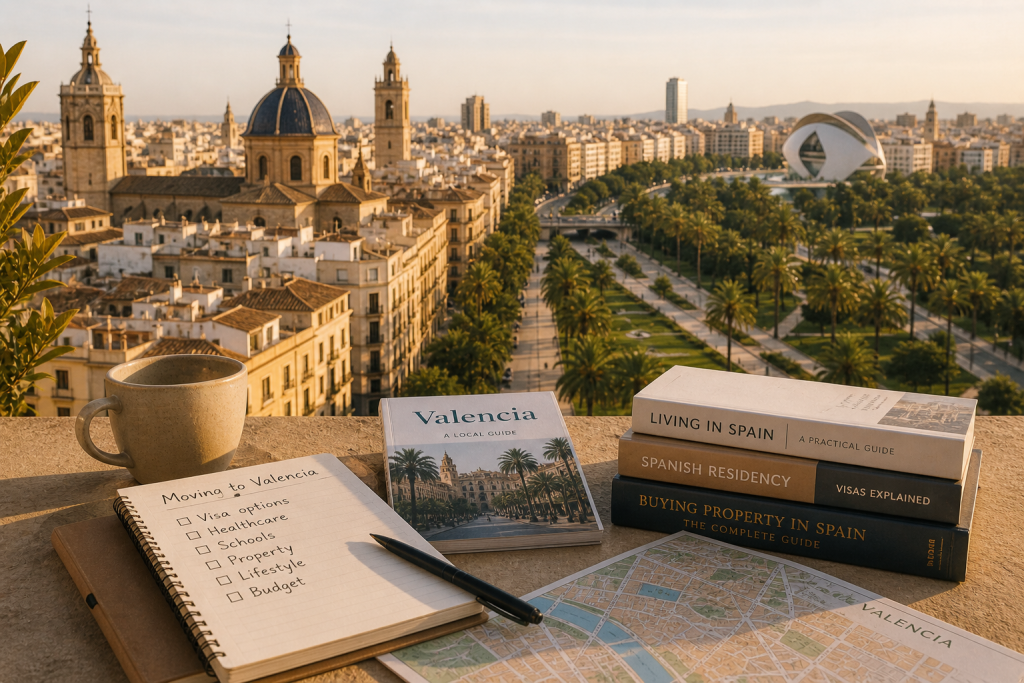


Valencia has become one of the most asked-about international relocation destinations in Europe, particularly for buyers from the US, UK, the Netherlands, Germany, and Scandinavia. The reasons are not abstract — they are practical, measurable, and increasingly hard for other Spanish cities to match. This guide is the version of the conversation we have most weeks with new clients.
The short answer
Valencia is, in our view, the strongest balance of affordability, livability, and infrastructure of any major Spanish city in 2026. International buyers can purchase property here without restriction. Most non-EU expats relocate using either the Non-Lucrative Visa (passive income) or the Digital Nomad Visa (remote work). EU citizens can settle freely. The cost of living is roughly 30–60% below comparable cities in the US, UK, or Northern Europe, depending on lifestyle. Healthcare ranks among the strongest in the European Union. The buying process, with the right legal and advisory support, takes six to ten weeks.
What follows fills in the practical detail.
Why Valencia, specifically
Valencia is the third-largest city in Spain, but it does not feel like one. The historic centre is walkable. Public transport is consistently rated among the best in Europe. The Turia — eight kilometres of green linear park converted from the old riverbed — runs through the city and is, in our view, the single best urban amenity in any Spanish city.
What makes Valencia distinct from Madrid and Barcelona for an international buyer:
- Property prices remain materially lower than Barcelona, and meaningfully lower than central Madrid, while quality of life metrics (air quality, walkability, public transport, green space) are arguably stronger.
- The international community is established but not dominant. Expats integrate rather than concentrate, which most clients eventually identify as the right balance.
- The climate — over 300 days of sun annually, a Mediterranean shoreline within twenty minutes of any neighborhood, mountains within an hour.
- Infrastructure for remote work and family life — fibre internet is universal, international schools are accessible, the airport is a 25-minute taxi ride from the centre with direct connections to most European capitals.
Cost of living in Valencia in 2026
The number that surprises most arrivals is rent. As of early 2026, monthly budgets for a comfortable middle-class lifestyle in central Valencia typically fall within these bands:
| Household | Rent (central, comfortable) | Total monthly budget |
|---|---|---|
| Single person | €700–€1,200 | €1,300–€1,900 |
| Couple | €900–€1,600 | €1,900–€2,700 |
| Family of four | €1,400–€2,200 | €2,800–€3,800 |
Total budget includes rent, utilities, food, transport, basic healthcare, and a normal allowance for restaurants and leisure. Premium districts (Pla del Real, certain new-build along Avenida Aragón) and beach proximity (Patacona, Cabanyal front-line) push rent toward the upper bound. Inland and student-leaning neighborhoods (Benimaclet) sit at the lower bound.
How Valencia compares to where you are moving from
From the United States
Rent in central Valencia is roughly 60–75% lower than New York City or San Francisco for an equivalent apartment, and approximately 35–55% lower than mid-tier US cities such as Austin, Denver, or Boston. Restaurant pricing is broadly half. Healthcare, even private, is a fraction of US out-of-pocket costs.
What changes for US buyers: the buying process itself is more legally structured (the role of the notary, mandatory deposits, and the registration in the Registro de la Propiedad), but transparently so. Capital gains and worldwide income reporting via the IRS continues to apply — Spain and the US have a tax treaty, but US citizens remain US tax residents wherever they live. We refer clients to specialist US-Spain tax advisors at the right point in the process.
From the United Kingdom
Post-Brexit, UK buyers are now treated as non-EU nationals — meaning a visa is required to live in Spain longer than 90 days in any 180. The two main routes (Non-Lucrative and Digital Nomad) are detailed below. UK buyers can still purchase property without restriction, regardless of residency status.
Cost-of-living comparison: rent in central Valencia is 40–60% lower than central London, and 15–35% lower than mid-tier UK cities such as Manchester, Bristol, or Edinburgh. The wider differential becomes most visible in healthcare, dining, and childcare.
From the Netherlands and Germany
Cost of living differential is narrower (Valencia is roughly 20–35% cheaper than Amsterdam or Munich on equivalent housing) but the quality-of-life gain is meaningful — climate, outdoor lifestyle, and density of usable green space. Dutch and German buyers are typically our most prepared clients, often arriving with a clear thesis on neighborhood, building type, and budget.
EU citizens can settle in Spain without a visa, but must register with the local authorities (the Empadronamiento) and obtain an EU residence certificate within three months of arrival.
From Scandinavia
Cost of living differential is similar to the Dutch / German comparison. The most common driver we see is climate and a reduction in mortgage and tax burden compared to Norway, Denmark, or Sweden. Scandinavian buyers tend to favor either central Valencia or Patacona for the urban-and-beach combination.
Visas and residency for expats
For non-EU citizens (US, UK, Canada, Australia, etc.), three primary routes are relevant in 2026.
| Visa | Best for | Key requirement |
|---|---|---|
| Non-Lucrative Visa (NLV) | Retirees, individuals with passive income, those not working in Spain | Demonstrate ~€2,400/month income or savings (400% of IPREM), plus ~€600/month per dependent |
| Digital Nomad Visa (DNV) | Remote workers employed by a non-Spanish company, or freelancers with non-Spanish clients | ~€2,650/month income (200% of Spanish minimum wage); up to 20% of work may be for Spanish clients |
| Lucrative / Work Visa | Buyers with a Spanish employer or starting a Spanish business | Job offer or business plan + capital; significantly more complex than NLV / DNV |
The Golden Visa real estate route was discontinued on 3 April 2025. Investing in Spanish property no longer grants residency. This is a frequent point of confusion in older guides — consider any source that recommends “Spain Golden Visa via real estate” as outdated.
For EU citizens, no visa is required. Registration as an EU resident is straightforward and we handle it for clients as part of the wider relocation support.
Can foreigners buy property in Valencia?
Yes — without restriction. There is no Spanish equivalent of the residency-tied property rules that exist in some other European countries. The only document a foreign buyer needs is a NIE (Número de Identificación de Extranjero) — the Spanish foreigner tax number. We handle the NIE process for international clients as part of the purchase.
The buying process itself, the costs (typically 10–14% on top of the purchase price), the role of the lawyer and notary, and the typical 6–10 week timeline are covered in depth in our pillar guide: Buying Property in Spain as a Foreigner — A Complete 2026 Guide. The purchase costs calculator gives a quick number for any specific property.
Whether to rent or buy is the more common question we get. For relocations longer than three years and for buyers with a clear use case (primary residence, family home, second home with regular use), buying typically makes financial sense — Spanish residential prices have risen consistently across cycles, and rental costs in central Valencia have moved meaningfully upward in 2024–2025. For shorter or uncertain stays, renting first is the right call.
Where to live in Valencia as an expat
Choosing a neighborhood is the single decision that most shapes daily life — and the one most under-researched by international buyers before they arrive. We have written a full companion guide on this: Best Areas to Buy Property in Valencia — A 2026 Buyer’s Guide, which covers Ruzafa, Pla del Real and Mestalla, Ciutat Vella, El Cabanyal, Patacona, and Benimaclet in depth.
For relocating expats specifically, the practical short list:
- Pla del Real and Mestalla — the most consistently liveable central area for retirees and families. Walkable to the Turia, near international schools, larger apartments. Our office is here, by choice.
- Ruzafa — the cultural and social centre of expat Valencia. Best for urban couples and second-home owners. Loud at night.
- Patacona / Alboraya — modern beachfront, family-friendly, the strongest concentration of Northern European international buyers. Car-dependent for daily city access.
- El Cabanyal — beachfront, lower-rise, in active transition. Good for lifestyle buyers comfortable with a neighborhood that is still becoming.
If your search includes the wider region, we cover the Costa Blanca separately: Where to Buy on the Northern Costa Blanca — Altea, Polop, Jávea.
Healthcare, schools, and daily life
Spain’s public healthcare system (the Sistema Nacional de Salud) is among the strongest in Europe by any measurable outcome. Once you are a legal resident and registered, public healthcare is included. Most expats also carry private insurance — €60–€150 per person per month for a comprehensive plan with the major Spanish providers (Sanitas, Adeslas, DKV, Asisa). Private hospitals in Valencia are excellent and waiting times are short.
For families, Valencia has a strong international school catchment: Cambridge House, Caxton College, El Plantío International School, and several others within thirty minutes of central Valencia. Annual fees range from €7,000 to €15,000 per child. We coordinate school selection and application as part of our family relocation support.
Daily life in Valencia is paced more slowly than in Northern European or US cities, with a meaningful afternoon break, an evening culture that runs late, and a year-round outdoor rhythm. For most relocating clients, this becomes the principal — and unexpected — long-term reason they stay.
Common mistakes when relocating to Valencia
- Renting in the wrong neighborhood for the first year. Once a long-term lease is signed, mobility is limited. Spend two weeks in a short-term rental in your candidate neighborhood before committing.
- Underestimating purchase costs. Beyond the 10–14% transaction overhead, factor in furnishing, community fees, and any renovation. Working backwards from a total cost-of-acquisition number rather than an asking price avoids surprises.
- Trusting the seller’s lawyer. Always engage independent legal counsel. The cost (€1,500–€3,500 for a standard purchase) is among the cheapest insurance you will buy.
- Buying based on photographs. Light orientation, building noise, the specific block, and the upstairs neighbour are not visible in a listing. We always advise an in-person second viewing at a different time of day.
- Assuming the Golden Visa via real estate still exists. It does not — discontinued April 2025. Plan visa strategy via NLV, DNV, or other routes.
- Tax planning after the fact. Spanish tax residency rules (183 days, family ties, economic ties) apply automatically. Have a Spanish tax advisor review your structure before you move, not after.
Why a boutique advisory matters for international buyers
Most Spanish real estate agencies are organised around volume — large listing inventories, generalist agents, commission structures aligned with vendors. For a local buyer transacting in their first language and home market, that model often works.
For an international buyer relocating from another country, the model is the wrong shape. The questions are not just “which property” — they are “which neighborhood for my children’s school”, “which visa for my income source”, “which lawyer can I trust”, “what does this contract clause actually mean in Spanish law”, “what does this comunidad’s reserve fund tell me about the building”. These are advisory questions, not listing questions.
reSELECTA is structured around this. We work buyer-side only, with a small number of international clients at a time, end-to-end through the relocation and the purchase. Our markets are Valencia city and the northern Costa Blanca. We turn down searches outside that geography by design.
Frequently asked questions
Is Valencia safe for expats?
Valencia is consistently among the safest large cities in Europe. Standard urban awareness applies — pickpockets in tourist zones, normal precautions late at night — but violent crime rates are very low.
Is Valencia cheaper than Barcelona?
Yes, materially. Valencia property prices are typically 30–45% below central Barcelona for equivalent stock; rent is typically 25–40% below; cost of living is approximately 15–25% lower overall.
Can Americans live in Valencia full-time?
Yes, with the appropriate visa. The Non-Lucrative Visa or Digital Nomad Visa cover most US relocations. US tax obligations continue to apply on worldwide income; the US-Spain tax treaty provides relief from double taxation but requires correct structuring.
Can UK citizens still move to Valencia after Brexit?
Yes. UK citizens are now treated as non-EU nationals and require a visa for stays beyond 90 days in any 180. Property purchase is unaffected by residency status.
Do I need to speak Spanish to live in Valencia?
For day-to-day life in expat-leaning neighborhoods, no — English suffices in many contexts. For navigating bureaucracy, healthcare appointments, or local services beyond the centre, basic Spanish makes life materially easier. Most relocating clients reach functional Spanish within twelve to eighteen months.
Is it better to rent or buy?
For relocations of three years or longer with a clear use case, buying typically makes sense — Spanish residential prices have risen consistently across cycles, and central Valencia rental costs moved up sharply in 2024–2025. For shorter or uncertain stays, rent first.
How long does the buying process take?
Six to ten weeks from accepted offer to completion for resale property with clean title. Off-plan purchases run longer, depending on construction stage.
Sources and further reading
Cost-of-living and pricing comparisons in this article are based on our internal market data for Valencia and cross-referenced with Idealista’s residential price index and Fotocasa’s market index for late 2025 to early 2026. International comparisons (US, UK, NL, DE) are based on Numbeo’s cost-of-living dataset with our own adjustments for central versus peripheral pricing.
For visa and residency rules, the canonical sources are the Spanish Ministry of Foreign Affairs visa portal and the Ministry of Inclusion’s foreigner registry portal. The Non-Lucrative Visa income threshold (400% of IPREM) and the Digital Nomad Visa threshold (200% of minimum wage) are both indexed and update annually — verify the current figure before submitting an application.
For property and legal records, the two official Spanish databases that matter are the Registro de la Propiedad (Land Registry) and the Catastro (cadastral records). Your lawyer should pull both for any purchase.
Where to start
If you are early in your move-to-Valencia research, two practical next steps:
- Read the buying mechanics. The visa and lifestyle questions are one half of the relocation. The buying process is the other. Our complete guide to buying property in Spain as a foreigner walks through it end to end.
- Talk to an advisor before you arrive. The single highest-leverage hour you can spend on a Spanish relocation is a structured conversation about your specific brief — visa fit, neighborhood logic, school catchment, tax structure — before the first viewing trip. We run this as a paid Strategy Session; details on the services page.
If you would like a private read on whether Valencia, the Costa Blanca, or neither fits your specific brief, that conversation is what we exist to have. Get in touch.