
Where to Buy on the Northern Costa Blanca: Altea, Polop, Jávea
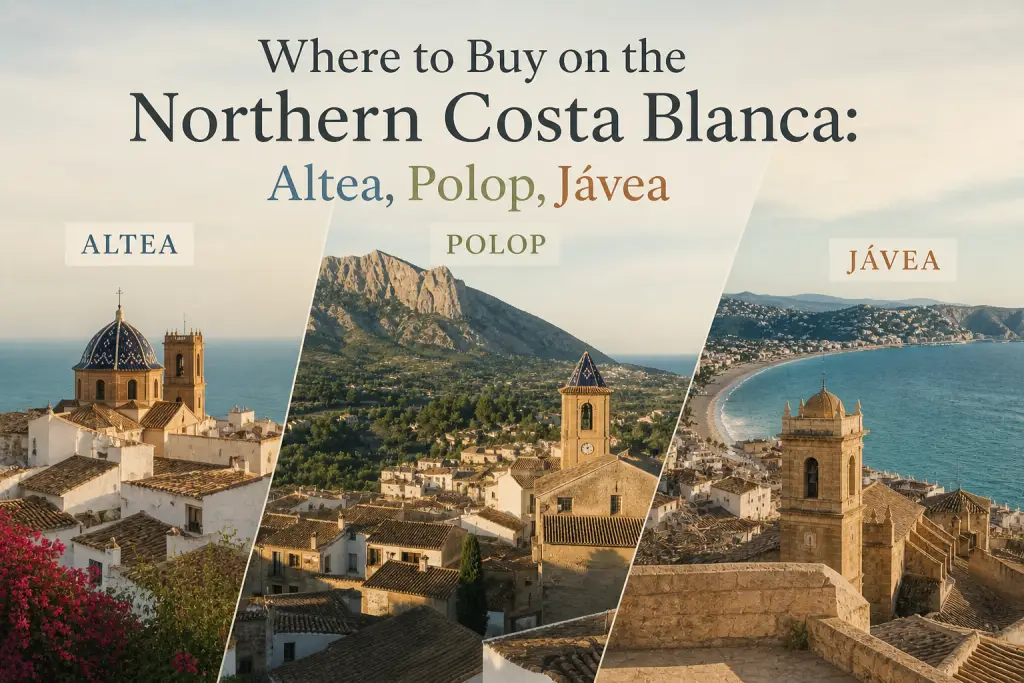
The northern Costa Blanca is not one market. It is a thirty-kilometre stretch of coastline and inland villages that read very differently from each other once you have walked them. Altea, Polop, and Jávea are the three towns we work in most often — each suits a different buyer, and the costliest mistake an international buyer makes is assuming they are interchangeable.
How to read the northern Costa Blanca
Before any town comparison, two framing notes that matter more than most buyers realise.
Inland versus coastal is not the same axis as cheap versus expensive. A villa with a sea view in Polop, ten minutes inland, can be priced lower than a smaller apartment in Jávea Arenal — but it will also live very differently. Inland means car-dependent, mountain mornings, more privacy, less foot traffic. Coastal means walk-to-restaurant convenience, more density in summer, premium pricing on front-line stock. Neither is “better”; they are different lifestyles dressed in similar marketing.
The Costa Blanca is built on urbanizaciones. Most of what an international buyer ends up purchasing here is not a freestanding villa on its own land but a property inside a private residential development with shared roads, communal pools, and a community of owners (a comunidad de propietarios). The quality of the urbanización matters as much as the quality of the house. We come back to this near the end of the article.
With that in mind, the three towns.
Altea — village charm, established premium
Altea is the most picturesque of the three: a whitewashed hilltop old town with a blue-domed church, a working seafront, a marina, and a long-standing community of artists, musicians, and second-home owners from across Northern Europe. It has been “discovered” for forty years, which means the prices reflect that — but also means the infrastructure, services, and overall feel are mature in a way the newer Costa Blanca towns are not.
Three sub-areas matter for a buyer:
- Altea Old Town (Casco Antiguo) — narrow lanes, white houses, the famous blue-tiled dome. Beautiful to visit, complicated to live in: stairs everywhere, no parking, restored period houses with quirks. Suits a specific buyer.
- Altea seafront and Altea La Vella — the lower town, with apartments along the promenade, the marina, and the residential plain extending inland. The most “everyday” Altea — walkable, with shops and cafés, and the highest concentration of resale apartments and modern townhouses.
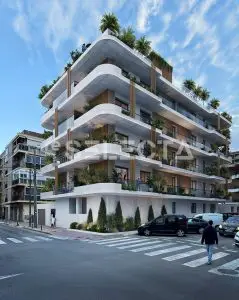
- Altea Hills — a private residential enclave on the hillside above the town. Villa-only, gated, panoramic sea views, premium pricing. We have placed a number of clients here and the demand stays consistent. A current Altea Hills listing for context.
Indicative pricing: resale apartments in central Altea typically run €2,800–€4,500 per m². Villas in Altea proper sit roughly €3,500–€6,000 per m² depending on plot, view, and condition. Altea Hills is its own market — €4,500–€8,000 per m² is normal, with premium product clearing higher.
Best fit: retirees, second-home buyers, anyone who values an established community over emerging value, and clients prioritising a sea view from a villa. Less ideal for buyers chasing the lowest entry price or for families needing wide flat green space.
Polop — inland, valley-quiet, where Altea overflows
Drive ten minutes inland from Altea and the landscape opens into the valley of Polop — a small village built around a hilltop castle, with the dramatic Sierra Bernia ridge framing the north and views back toward the Mediterranean. Polop has historically been quieter, slower, and meaningfully cheaper than coastal Altea. Over the last decade, as Altea has filled, more international buyers have started building or buying here — and the new-build product has followed.
What you get in Polop that you typically cannot in Altea:
- Larger plots for the same money — villas with substantial private land become realistic.
- Genuine quiet — Polop is not a tourist town. Most of the year it is residential and Spanish.
- Mountain mornings combined with sea views from the right elevation. We have a current listing where this trade is on full display: villa in Polop with the Altea coastline visible from the terrace.
What you give up:
- Walkable beach access. Polop is a 10–15 minute drive to the coast.
- Concentration of restaurants and amenities. The village core is real but small.
- Resale liquidity speed. Buyers typically take longer to find a Polop property than an Altea apartment, in both directions.
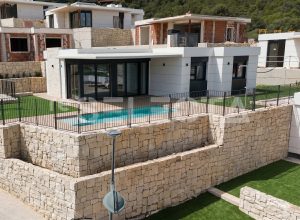
Indicative pricing: €1,800–€3,500 per m² for resale, with significant variance between village houses, older urbanización stock, and recent new-build. New-build villas with sea views typically come in around €2,800–€4,200 per m². Two of our current listings give a sense of the upper end of the new-build market: Modern Villa in Polop with sea views and pool and Luxury Villas in Polop.
Best fit: buyers who want privacy, a real plot, mountain-and-sea views, and don’t mind being inland. Particularly strong for retirees who want quiet, second-home owners with a car, and buyers who value space over walkability.
Jávea (Xàbia) — three towns in one
Thirty kilometres up the coast from Altea sits Jávea — known as Xàbia in Valenciano, both names in active use. Jávea is the most internationally populated of the three, with a particularly strong British, Belgian, and Dutch presence, and the most family-driven of the three markets. It is also structurally different: Jávea is not one place but three distinct nuclei, and where you buy inside Jávea changes the experience completely.
- Jávea Old Town (Pueblo) — the historic centre, set back two kilometres inland on a low hill. Sandstone architecture, the fortified church, narrow streets, the most “Spanish” of the three areas. Limited tourist crush, mid-pricing.
- Jávea Port (Puerto) — the working harbour and the line of seafront restaurants north of it. Walkable, mature, year-round community. The natural answer for buyers who want walk-to-everything coastal living without the resort feel.
- Jávea Arenal — the long sandy beach south of the cape, with the resort strip behind it. The most family-driven, most international, most summer-busy. Buying close to Arenal means you walk to the beach; the trade is summer density.
The bay itself is framed by two capes (Sant Antoni and La Nau) which create a microclimate that is meaningfully different from open Costa Blanca — calmer water, less wind, denser vegetation. This is part of why the area attracts the buyers it does.
Indicative pricing: Old Town apartments €2,800–€4,500 per m², Port area €3,200–€5,000 per m², Arenal beach proximity €3,500–€5,500 per m². Villas in the surrounding hills (Cap Martí, La Lluca, Tossalet, La Granadella) span €3,500 to €7,000+ per m² depending on plot and view.
Best fit: families relocating with school-age children (Jávea has a strong international school catchment), buyers wanting an established expat community, lifestyle buyers prioritising the sea over the mountains. Less ideal for buyers seeking quiet authenticity (the Old Town aside) or maximum value.
Benidorm, Calpe, Moraira, Benissa — when do these make sense
Outside the three core towns, four nearby names come up often in buyer conversations.
- Benidorm — the largest and most touristic. We do not generally recommend Benidorm for premium buyers because the value of property is structurally tied to mass-tourism demand, which compresses long-term capital growth and makes off-season life thinner than in Altea or Jávea. There are pockets — Sierra Dorada, Rincón de Loix’s quieter end — where a particular buyer may find what they want, but it is not where we usually start.
- Calpe — the rock (Peñón de Ifach) is iconic, but most of the residential stock around it is high-rise apartment built in the 1970s–90s. Some new-build is good. Selectively recommend.
- Moraira — small, exclusive, almost no high-rise, very quiet. Effectively a more expensive, more private version of Jávea Old Town’s mood. Worth a look for retirees with a higher budget.
- Benissa — inland-leaning village with a short coastal frontage (Benissa Costa). A solid mid-tier alternative for buyers who like the Polop logic but want to be closer to the Jávea side of the coast.
A note on urbanizaciones
Most villa purchases on the Costa Blanca happen inside an urbanización. This is a critical point that deserves the same scrutiny as the property itself. Three things to verify before you sign anything:
- Read the comunidad accounts. Every urbanización has a community of owners with a budget, a reserve fund, and a recent history of major works. A poorly run comunidad with deferred maintenance is buying a future special-assessment bill.
- Confirm the legal status of the urbanización. Some older developments have unresolved planning issues, unfinished infrastructure handover to the municipality, or ongoing litigation. Your lawyer should pull this. The vendor’s lawyer will not volunteer it.
- Match the urbanización to your use case. A pool-and-tennis-court family complex feels different to a quiet adults-only enclave. Your monthly community fees, your noise level, and your resale demographic are all set by the urbanización choice.
None of this is a reason to avoid urbanizaciones — most of our Costa Blanca clients buy in good ones happily. It is a reason to view the urbanización as part of the purchase, not the wrapper around it.
Match your profile to a town
| If you are… | Look first at |
|---|---|
| A retiree wanting an established expat community by the sea | Altea, Jávea Port |
| A second-home owner, used 2–3 months per year | Altea Hills, Jávea Arenal, Moraira |
| A family relocating with school-age children | Jávea (any of the three areas) |
| A buyer wanting a real plot, privacy, and mountain views | Polop, Benissa |
| A buyer prioritising new-build villa with sea view at sensible cost | Polop |
| A buyer specifically wanting walkable old-town life | Altea Old Town, Jávea Old Town |
| A buyer seeking the lowest entry price | Polop or Benidorm — but read the urbanización section above carefully |
Sources and further reading
Pricing ranges in this article reflect our reading of late-2025 to early-2026 residential market data on the northern Costa Blanca, drawn from Idealista’s price index reports and Fotocasa’s market index, cross-referenced against our own working data on closed transactions in Altea, Polop, and Jávea. Numbers shift month to month — treat the ranges as a calibration tool, not a quote.
For the legal-due-diligence points raised in A note on urbanizaciones, the two official Spanish records that matter to any Costa Blanca buyer are the Registro de la Propiedad (the Spanish Land Registry — confirms ownership, charges, and encumbrances) and the Catastro (the cadastral record — confirms the physical description of the property and its tax reference). Your lawyer should pull both. Neither check is optional on a Costa Blanca purchase given how many older urbanizaciones carry unfinished planning histories.
For visa and residency rules referenced indirectly throughout this guide, the canonical source is the Spanish Ministry of Foreign Affairs — see the national visa portal. We cover these in more depth in our pillar guide, Buying Property in Spain as a Foreigner.
Where to start
If you are early in your Costa Blanca research, three practical next steps:
- Read the costs side. Town selection is one variable; full purchase cost is another. Our complete guide to buying property in Spain as a foreigner covers the buyer process end to end. The purchase costs calculator gives a quick number for any specific property.
- If Valencia city is also on your shortlist, see our companion guide to the six Valencia neighborhoods worth a buyer’s attention. Different lifestyle, different building stock, often the right answer for a different kind of buyer.
- Walk the shortlist before you decide. Reading about Altea is not the same as standing in Altea Hills at sunset, or in Polop on a Tuesday morning. We run structured one-day previews for clients on the Costa Blanca — see the Strategy Session and Property Preview Trip.
If you’d like a private read on which of these towns fits your specific brief and budget, that conversation is what we exist to have. Get in touch.