
Non-Lucrative Visa Spain: A Complete Guide for Property Buyers

The Non-Lucrative Visa is the most straightforward route to legal residency in Spain for non-EU citizens who want to live here without working. For buyers from the UK, the United States, Canada, Australia, and other non-EU countries who are purchasing property in Valencia or the Costa Blanca with the intention of spending significant time in Spain, it is the visa category that most directly applies. Here is a clear account of how it works.
What is the Non-Lucrative Visa?
The Non-Lucrative Visa (Visado de Residencia No Lucrativa) is a Spanish long-stay visa that allows non-EU nationals to reside in Spain without engaging in any professional or commercial activity. You can live in Spain on this visa; you cannot work in Spain for a Spanish employer or conduct business activities while on it.
It is designed for people who can support themselves financially from income generated outside Spain – pensions, investment income, rental income from properties abroad, savings, or any other passive or foreign-sourced income. It is the standard route for British retirees and semi-retirees, wealthy international buyers who want a primary or secondary residence in Spain, and anyone who has the financial means to live in Spain without needing to earn locally.
The NLV is not to be confused with the Golden Visa (which requires a €500,000+ property investment and is being phased out) or the Digital Nomad Visa (which allows remote work for non-Spanish employers).
Who qualifies for the Non-Lucrative Visa?
The NLV is open to any non-EU national. The core eligibility requirement is financial: you must demonstrate sufficient income or savings to support yourself (and any dependants) during your stay in Spain without working.
Income requirement. The Spanish government sets a minimum income threshold based on the IPREM (Indicador Publico de Renta de Efectos Multiples – the Spanish public income index). For 2025, the standard requirement is approximately:
- Primary applicant: approximately €2,400 per month (400% of monthly IPREM)
- Each additional dependant (spouse, child): approximately €600 per month additional
These figures are reviewed periodically. The income must be demonstrably passive or foreign-sourced – a pension, investment dividends, rental income from property abroad, or similar. Consulates interpret the evidence differently, so presenting it clearly matters.
Clean criminal record. A police clearance certificate from your home country (and any country where you have lived in the past 5 years) is required. It must be apostilled and officially translated into Spanish.
Health insurance. You must hold a private health insurance policy valid in Spain with no co-payments and no coverage gaps. Spanish public healthcare is not available on the NLV until you have been a resident for some time. The insurance must be from a company authorised to operate in Spain.
No criminal convictions in Spain. Checked automatically by the Spanish authorities during the application process.
How to apply: step by step
The NLV application is made at the Spanish consulate in your home country – not in Spain. You cannot apply for it once you are already in Spain (you would need to leave and apply from your home country).
Step 1 – Gather your documents. The full document list (see below). Allow 2-3 months for this stage – some documents take time to obtain and must be apostilled and translated.
Step 2 – Book a consulate appointment. Spanish consulates in the UK (London, Manchester, Edinburgh), Netherlands (Amsterdam), Germany (Berlin, Munich, Frankfurt, Hamburg, Dusseldorf) and other countries handle NLV applications. Appointment availability varies significantly – book as far in advance as possible. In London the wait can be several weeks.
Step 3 – Submit the application. Present your documents at the consulate appointment. The consulate reviews the application and may request additional documentation.
Step 4 – Wait for a decision. Processing time is typically 1-3 months. You will be notified when a decision is made.
Step 5 – Collect the visa. If approved, collect the visa sticker from the consulate. The initial NLV is issued for one year.
Step 6 – Enter Spain and register. Within 30 days of arriving in Spain, you must register at your local Extranjeria (foreigners) office to obtain your TIE (Tarjeta de Identidad de Extranjero) residency card. This is the card you will carry as your Spanish residency document.
Documents required
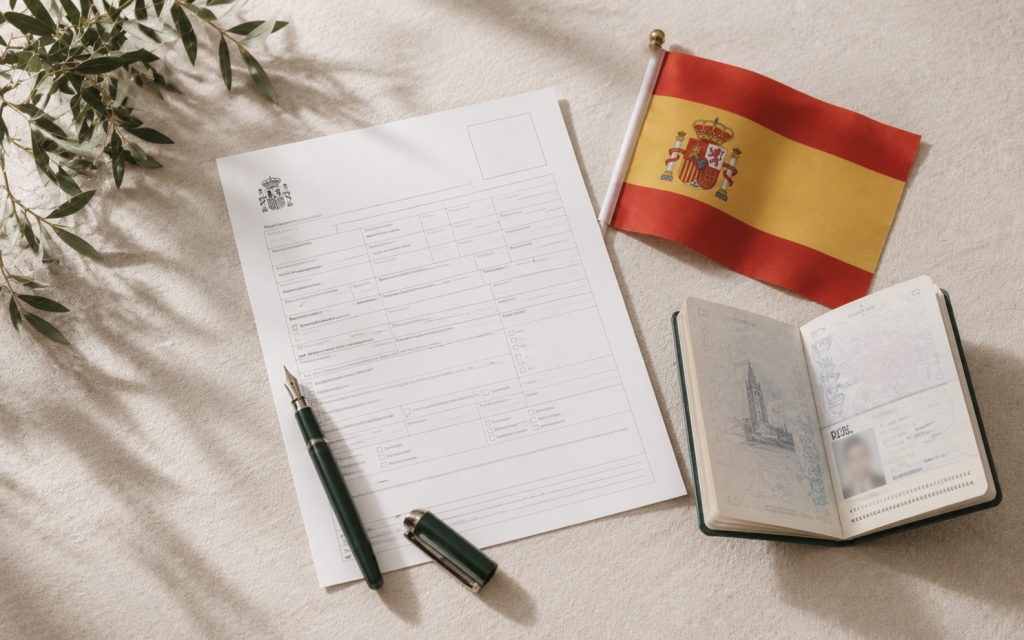
- Completed visa application form (EX-01)
- Valid passport with at least one year validity remaining (original + copy of all pages)
- Two recent passport photographs
- Criminal record certificate from your home country – apostilled and officially translated into Spanish
- Medical certificate confirming no contagious diseases – from a doctor, apostilled and translated
- Private health insurance certificate valid in Spain with no co-payments, no exclusions for pre-existing conditions, covering the full period of residence
- Proof of income – bank statements (typically 6-12 months), pension statements, investment income documentation, or a combination. Must clearly demonstrate the monthly income threshold is met
- Proof of accommodation in Spain – a property purchase deed, rental contract, or equivalent
- For dependants: marriage certificate (apostilled and translated), birth certificates for children (apostilled and translated)
All non-Spanish documents must be apostilled by the relevant authority in your home country and officially translated into Spanish by a sworn translator (traductor jurado). This step takes time – plan for it.
Renewal and the path to permanent residency
The initial NLV is valid for one year. It is renewed in Spain (not at the consulate) for two-year periods:
- Year 1: Initial visa, obtained at consulate
- Years 2-3: First renewal (two years) – applied for in Spain at your local Extranjeria office
- Years 4-5: Second renewal (two years)
- Year 5+: Eligible to apply for long-term residency (residencia de larga duracion)
- Year 10+: Eligible to apply for Spanish citizenship (subject to language test and other requirements)
An important requirement for renewal: you must spend at least 183 days per year in Spain to maintain your NLV residency status. This also has tax implications – spending more than 183 days in Spain in a calendar year makes you a Spanish tax resident, with obligations to declare worldwide income to the Spanish tax authority (Hacienda).
NLV and property purchase: how they connect
Many international buyers purchase property in Valencia or the Costa Blanca and then apply for the NLV to formalise their right to live there. The property purchase deed (escritura) serves as proof of accommodation for the visa application, which is one of the required documents.
The sequence most buyers follow: identify and purchase a property, then apply for the NLV from their home country using the escritura as proof of accommodation. This means the property purchase typically happens first, and the visa application follows.
It is worth noting that owning property in Spain does not automatically give you the right to reside there beyond the 90-day Schengen visitor limit. The NLV is the formal step that converts property ownership into legal residency.
FAQ
How much income do I need for the Non-Lucrative Visa Spain?
For 2025, the primary applicant needs to demonstrate approximately €2,400 per month in passive or foreign-sourced income – around 400% of the Spanish IPREM index. Each additional dependant (spouse, child) adds approximately €600 per month to the requirement. These figures are updated periodically. Present clean, documented evidence of income – bank statements, pension letters, investment statements – rather than a single lump sum.
Can I work in Spain on the Non-Lucrative Visa?
No. The NLV explicitly prohibits any professional or commercial activity in Spain. You cannot work for a Spanish employer, operate a Spanish business, or offer freelance services to Spanish clients. You can receive passive income from abroad – dividends, pension, rental income from foreign properties – without restriction. If you need to work remotely for a non-Spanish employer, the Digital Nomad Visa is the appropriate route instead.
Do I need to own a property to apply for the NLV?
No – you need proof of accommodation in Spain, which can be a rental contract as well as a purchase deed. However, many buyers apply using their property purchase deed as the accommodation proof. Owning property is not a requirement; having a legal place to live in Spain is.
How long does the Non-Lucrative Visa application take?
Allow 3-6 months from starting document preparation to receiving your visa. Document gathering and apostille/translation typically takes 2-3 months. Consulate appointment waiting times vary by location. Processing after submission is typically 1-3 months. Do not plan to move to Spain on a specific date without significant buffer time.
What happens if I spend too much time outside Spain on the NLV?
You must spend at least 183 days per year in Spain to maintain your NLV residency status for renewal purposes. Extended absences can jeopardise your renewal application. Conversely, spending 183+ days in Spain makes you a Spanish tax resident, which triggers worldwide income declaration obligations to Hacienda. Both the 183-day requirement and its tax implications should be discussed with a Spanish tax advisor before committing to the NLV path.