
How to Get Your NIE in Spain: A Practical Guide for Property Buyers


How to Get Your NIE in Spain: A Practical Guide for Property Buyers
If you are buying property in Spain, the NIE is the first bureaucratic step – and it causes unnecessary delays for buyers who leave it too late. Here is a clear account of what it is, what you need it for, and how to get it efficiently whether you are applying in Spain or from your home country.
What is the NIE?
The NIE – Numero de Identificacion de Extranjero – is a tax identification number assigned to foreign nationals in Spain. It is a nine-character code in the format X-0000000-X (letter, seven digits, letter). It does not grant residency and it does not expire. Once issued, it is yours permanently.
You need a NIE for any significant financial or legal transaction in Spain: buying property, signing a mortgage, opening a bank account, paying Spanish taxes, buying a car, or registering utilities in your name. Without it, a property purchase cannot proceed to completion.
Two ways to obtain it
There are two routes: apply in Spain in person, or apply through a Spanish consulate in your home country before you travel. Both produce the same result. Which is better depends on your circumstances.
Option 1 – Apply in Spain
NIE applications in Spain are handled by the National Police (Policia Nacional) at designated Extranjeria (foreigners) offices. You need to book an appointment (cita previa) in advance – walk-ins are not accepted at most offices.
What you need:
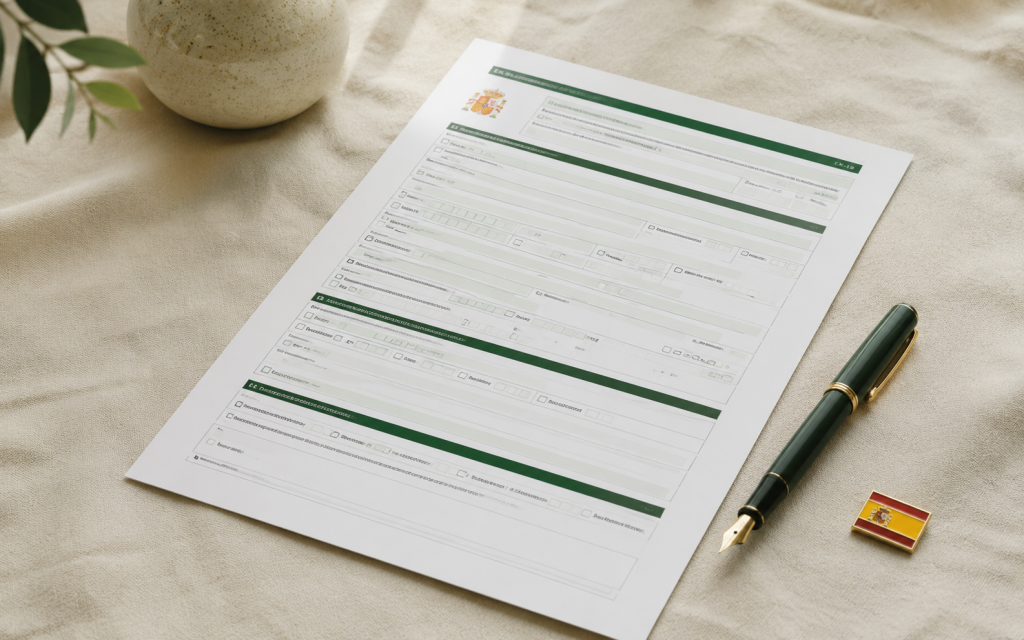
- EX-15 form (Solicitud de Numero de Identidad de Extranjero) – completed and signed in advance, available from the Spanish Interior Ministry website
- Original passport plus a photocopy of the photo page
- Proof of reason for the application – a letter from your solicitor confirming you are in the process of buying property is standard and universally accepted
- Payment of the tax (Tasa Modelo 790, Codigo 012) – currently €12.10, payable at a Spanish bank before your appointment
Timeline: The NIE certificate is typically issued on the same day as your appointment, or within a few days. The appointment itself is the bottleneck – in high-demand areas like Alicante and Valencia, cita previa slots can be booked out 3-6 weeks in advance during busy periods. Book as early as possible.
Power of attorney route: Many buyers appoint a Spanish solicitor (abogado) with power of attorney to obtain the NIE on their behalf. This removes the need to be physically present in Spain for this step and is entirely legal. If you are not yet in Spain and need the process to move quickly, this is often the most efficient route.
Option 2 – Apply at a Spanish consulate in your home country
Spanish consulates process NIE applications for non-resident foreign nationals. The documents required are essentially the same – EX-15 form, passport copy, proof of reason – but the consulate has its own appointment system and processing times vary by location.
In the UK, consulates in London, Manchester, and Edinburgh handle NIE applications. In Germany, the consulates in Berlin, Munich, and Frankfurt. In the Netherlands, the consulate in Amsterdam. Processing times range from a few days to several weeks depending on demand. Contact your nearest Spanish consulate for current appointment availability.
The advantage of the consulate route is that you don’t need to travel to Spain specifically for the NIE. The disadvantage is that processing can be slower and less predictable than an in-Spain application.
Common mistakes and how to avoid them
Leaving it too late. The NIE should be your first step, started as soon as you decide you are seriously looking. If you find a property and agree a price before you have a NIE, you may face delays of several weeks before you can sign even the reservation contract. Some sellers and developers will not hold a property that long without a signed agreement and deposit.
Confusing the NIE with the TIE. The TIE (Tarjeta de Identidad de Extranjero) is a residency card issued to EU citizens registering as residents in Spain. It contains your NIE number but is a different document. If you are buying property as a non-resident – which describes most foreign buyers – you need the NIE certificate, not the TIE.
Using an unreliable intermediary. There are companies that charge large fees to obtain NIEs on your behalf. In most cases your Spanish solicitor can handle this as part of their standard service, or the process is straightforward enough to do yourself. If you are paying more than €100-€150 for NIE assistance through a legitimate legal professional, ask for clarification on what the fee covers.
Not bringing proof of reason. The NIE is not issued to anyone who asks – you need to demonstrate a reason for needing it. A letter from your solicitor confirming you are purchasing property in Spain is the cleanest documentation. Some offices also accept a property reservation contract. Check with your solicitor what format your specific appointment location accepts.
After you have your NIE
Once your NIE is in hand, the purchase process can move at full speed. The next steps are typically: opening a Spanish bank account (your NIE and passport are sufficient), appointing a Spanish solicitor if you haven’t already, and beginning due diligence once you have identified a property.
The NIE certificate itself is a single sheet of paper. Keep a scan of it in addition to the original. Spanish administrative processes often request a copy, and originals can be misplaced.
If you are buying through reSELECTA, we can connect you with solicitors we work with regularly on the Costa Blanca and in Valencia who can handle NIE applications as part of their purchase support service.
FAQ
How long does it take to get a NIE in Spain?
If applying in Spain in person at a National Police station, the NIE certificate is typically issued the same day or within 2-3 days of your appointment. The bottleneck is the cita previa (appointment) – in high-demand areas, this can take 3-6 weeks to secure during peak seasons. If applying via a Spanish consulate in your home country, processing times range from a few days to several weeks. Apply as early as possible.
Can I get a NIE without going to Spain?
Yes, via two routes: apply at a Spanish consulate in your home country, or grant power of attorney to a Spanish solicitor who applies on your behalf in Spain. The power-of-attorney route is commonly used by property buyers and is entirely legal. Your solicitor handles the application and sends you the NIE certificate.
Do I need a NIE to buy property in Spain?
Yes. The NIE is required for any property transaction in Spain – it must be provided at the notary for the escritura (title deed) signing, and it is needed to open a Spanish bank account to hold the purchase funds. Without a NIE, a Spanish property purchase cannot complete.
How much does the NIE cost in Spain?
The official tax (Tasa Modelo 790, Codigo 012) is currently €12.10, payable at a Spanish bank before your appointment. If you use a solicitor with power of attorney to obtain it on your behalf, their fee for this service is typically included in their broader engagement or charged separately at €100-€200.
What is the EX-15 form?
The EX-15 is the Solicitud de Numero de Identidad de Extranjero – the official NIE application form. It is available to download from the Spanish Interior Ministry website (extranjeria.gob.es). Complete and sign it before your appointment. Your solicitor can complete it for you if applying under power of attorney.