
International Schools in Valencia and Costa Blanca (2026): Fees, Curricula, Comparison
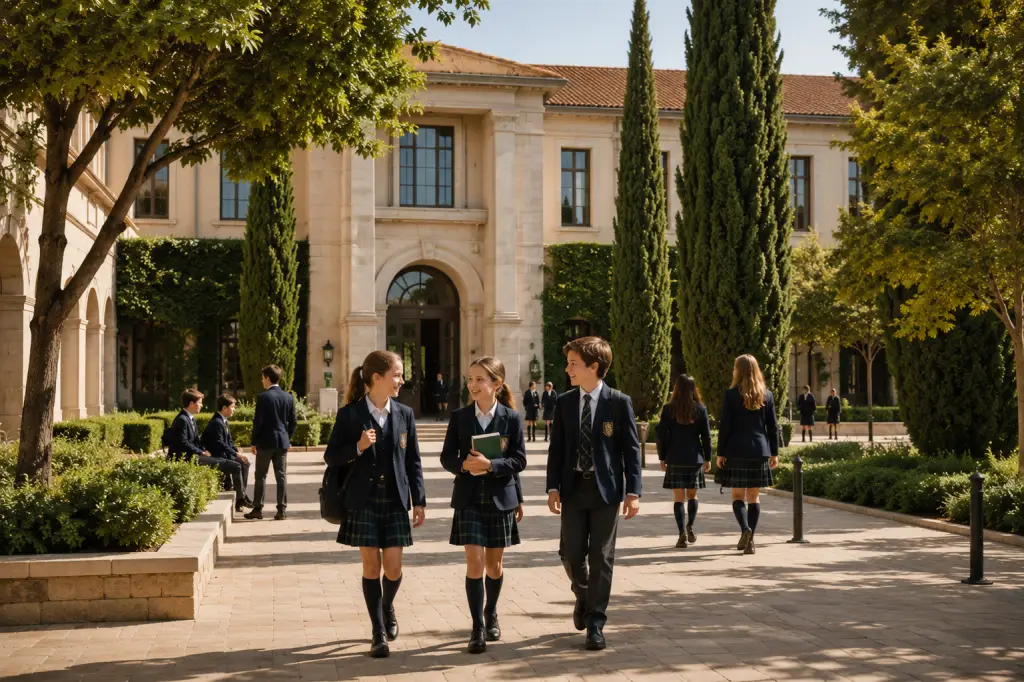
Valencia and the Costa Blanca together host around 30 international schools — most British curriculum, with American, IB, and French alternatives. Realistic 2026 annual fees: €5,500–€8,500 in primary, €7,500–€11,500 in secondary, €10,000–€15,000 in sixth form. For a foreign family with two children, the full annual cost (tuition plus registration, books, uniform, lunch, transport) typically lands between €22,000 and €40,000. Below are the schools that matter, grouped by area, with curricula, fee ranges, and what each is known for.
The headline picture
If you’re relocating to Valencia or the Costa Blanca with school-age children, three things shape every decision:
- Curriculum. Around 80% of international schools here are British (IGCSE / A-Levels). The remainder split between American (AP / US diploma), International Baccalaureate (IB), French (Lycée), and a small number of fully bilingual Spanish–English options.
- Location. Most schools sit in metropolitan rings, not city centres. Valencia’s international schools cluster in the northern crescent (Puçol, La Eliana, Rocafort, Bétera). On the Costa Blanca they spread along the coast from Dénia to Orihuela Costa.
- Capacity. The well-known schools have real waitlists — 6 to 18 months for popular year groups. Plan school applications before you finalise the house search, not after.
This guide covers what each school is, where it is, what it costs, and who it suits — in honest 2026 numbers. Fees vary by year group and update annually; figures here are indicative ranges and should be confirmed directly with each school before any commitment.
Curriculum options — what each one means
British curriculum (IGCSE → A-Levels)
The dominant model. Children follow the English National Curriculum from Reception (age 4–5) through Year 11 (IGCSEs, age 16), and continue to Years 12–13 (A-Levels, age 17–18). The qualifications are recognised worldwide and accepted at every major UK university plus most European and North American universities. Best fit if there’s any chance the family returns to the UK or sends children to UK universities.
International Baccalaureate (IB)
Three programmes — PYP (primary, 3–12), MYP (middle, 11–16), and the IB Diploma (16–18). Few schools in our coverage area run the full IB Continuum; most that offer IB do so only at Diploma level as a Sixth Form alternative to A-Levels. The IB Diploma is broader than A-Levels (six subjects plus extended essay, theory of knowledge, CAS) and favoured by families targeting US universities or who want academic breadth.
American curriculum (AP / US high school diploma)
Single school in Valencia (American School of Valencia), no major American school on the Costa Blanca. Pathway is K–12 with Advanced Placement (AP) courses in high school and a US high school diploma at graduation. Best fit for American families on temporary postings or families targeting US universities.
French curriculum (Brevet → Baccalauréat)
Lycée Français de Valencia is part of the AEFE network (French government schools abroad), partially state-subsidised, with fees notably lower than the British schools. Brevet at age 15, French Baccalauréat at age 18. Best fit for French families, Francophone families, or anyone planning university in France or Belgium.
Bilingual Spanish–English with international stream
A growing category. Schools like Mas Camarena (Bétera) and several private colegios offer a Spanish curriculum with strong English immersion and sometimes an international stream from secondary. Cheaper than full international schools, with proper Spanish integration. Best fit for families committing to long-term residence in Spain.
Cost structure — what fees actually include
The headline tuition is rarely the full cost. A realistic budget includes:
| Item | Range (per child, per year) |
|---|---|
| Annual tuition (Primary) | €5,500–€10,000 |
| Annual tuition (Secondary) | €7,500–€13,000 |
| Annual tuition (Sixth Form) | €10,000–€15,000 |
| Registration / inscription (first year, one-time) | €1,000–€2,500 |
| Annual enrolment fee | €400–€1,200 |
| Books and digital materials | €300–€800 |
| Uniform (first year) | €250–€500 |
| Lunch (10 months) | €900–€1,800 |
| School transport (bus) | €800–€2,500 |
| Extracurricular activities (per term) | €100–€400 |
| Trips, exam fees, miscellaneous | €300–€1,000 |
For a single child at a mid-tier British school in Valencia, plan around €12,000–€16,000/year all-in after Year 1. For two children, around €22,000–€32,000/year. For two children at premium schools (Caxton, King’s Alicante, Newton, Lady Elizabeth), realistic total can reach €35,000–€42,000/year.
Valencia metropolitan area — schools that matter
Almost every international school in Valencia sits outside the city ring road, in the northern and western residential crescent. Buyers concentrating their property search in central Valencia (Eixample, Ruzafa, Pla del Real, El Cabanyal) will need to factor a 20–40 minute school bus commute. Buyers in the northern villa belt (Puçol, La Eliana, Rocafort, La Cañada, Bétera) have schools within 10–15 minutes.
Caxton College — Puçol
Founded 1986. One of the largest international schools in the region, ~1,500 students. British curriculum, EYFS through A-Levels, with strong sports and arts programmes and substantial facilities. Indicative annual tuition: ~€8,500 primary, ~€10,500 secondary, ~€12,000–€13,000 Sixth Form. Registration ~€2,000. Long-established reputation, competitive admissions, real waitlists for popular years. Best fit for families wanting an established British institution with depth in extracurriculars.
British School of Valencia (BSV) — Valencia city
Founded 2007. Smaller school (~500 students) inside the city itself, which is the rare central option. British curriculum through A-Levels. Indicative annual tuition: ~€8,000 primary, ~€10,500–€11,500 secondary, ~€12,500 Sixth Form. Best fit for families committed to living in central Valencia who want to avoid a school commute.
Cambridge House Community College — Rocafort
Founded 1989. Long-established British school in Rocafort, ~15 minutes north of Valencia. ~1,000 students. IGCSE and A-Levels. Indicative annual tuition: ~€7,500 primary, ~€9,500–€10,500 secondary, ~€11,000–€12,000 Sixth Form. Often the choice for families settling in the L’Eliana–Rocafort–Bétera villa corridor.
Iale International School — La Eliana
Founded 1986. British curriculum with IB Diploma option at Sixth Form. Strong reputation for academic results. Indicative annual tuition: ~€8,000 primary, ~€10,000 secondary, ~€11,500 Sixth Form / IB. Best fit for families who specifically want the IB Diploma pathway alongside a British primary and secondary.
American School of Valencia (ASV) — Puçol
Founded 1980. The only fully American curriculum school in the region — K–12, Advanced Placement, US high school diploma, and an IB Diploma option. Indicative annual tuition: ~€8,500 primary, ~€11,000 secondary, ~€13,000 high school. Best fit for American families and families targeting US universities directly.
Lycée Français de Valencia — Paterna
Part of the AEFE network of French state-subsidised schools abroad. Full French curriculum from maternelle through baccalauréat. Indicative annual tuition: ~€3,500–€4,500 maternelle, ~€4,500–€5,500 primaire, ~€5,500–€6,500 collège/lycée. Materially cheaper than the British schools due to state subsidy. Best fit for French and Francophone families and those targeting French-speaking universities.
El Plantío International School — La Cañada (Paterna)
Smaller British school in La Cañada residential area. ~500 students. British curriculum through Sixth Form. Indicative annual tuition: ~€7,000 primary, ~€9,000–€9,500 secondary, ~€10,500 Sixth Form. Best fit for families in the La Cañada–Paterna villa zone who prefer a smaller-school environment.
Mas Camarena International School — Bétera
Bilingual Spanish–English school with an international stream and IB Diploma at Sixth Form. Large campus, ~2,000 students across all sections. Indicative annual tuition: ~€6,000 primary, ~€8,000–€9,000 secondary, ~€10,000 IB Diploma. Best fit for families planning long-term Spanish residence who want their children fluent in both languages and the Spanish system rather than fully isolated in an international bubble.
Globe School — Valencia city
Newer British school inside Valencia city, founded in the last decade. Smaller and rapidly growing. Indicative annual tuition: ~€7,500 primary, ~€9,500 secondary. Best fit for families wanting a fresh, smaller-scale option inside the city itself.
Costa Blanca — schools that matter
The Costa Blanca’s international schools spread along the coast roughly between Dénia and Orihuela Costa. Most are British, several with long histories of serving the substantial British and Northern European retiree and family communities along this coast. As a buyer, school location is one of the strongest drivers of where you actually live: the practical school commute defines a 15–30 minute radius around each school.
Northern Costa Blanca (Dénia, Jávea, Moraira, Altea)
Lady Elizabeth School — Llíber + Mijares
Founded 1986. Long-established British school with two campuses (Llíber for primary, Mijares for secondary) serving the Jávea / Benitachell / Moraira families. ~600 students. British curriculum through A-Levels. Indicative annual tuition: ~€7,500–€8,500 primary, ~€9,500–€11,000 secondary, ~€11,500–€12,500 Sixth Form. Best fit for families settling around Jávea, Benitachell, Teulada, Moraira.
Xabia International College — Jávea
British curriculum, IGCSE and A-Levels. ~500 students. Indicative annual tuition: ~€7,500 primary, ~€9,500–€10,500 secondary, ~€11,500 Sixth Form. Direct alternative to Lady Elizabeth for Jávea-based families, with the practical advantage of an in-Jávea campus rather than the inland Llíber location.
Sierra Bernia School — L’Alfàs del Pi
Founded 1973 — one of the oldest international schools on the Costa Blanca. ~700 students. British curriculum. Indicative annual tuition: ~€6,500 primary, ~€8,500–€9,500 secondary, ~€10,000 Sixth Form. Best fit for families settling between Altea and Benidorm — Polop, La Nucía, Altea, L’Alfàs del Pi.
Central and southern Costa Blanca (Alicante, Elche, Orihuela Costa)
Newton College — La Coveta Fumá (El Campello)
British curriculum with IB Diploma option at Sixth Form. ~1,000 students. One of the strongest academic reputations on the southern coast. Indicative annual tuition: ~€7,500 primary, ~€10,000–€11,000 secondary, ~€12,000–€13,000 Sixth Form / IB. Best fit for families in the El Campello / north Alicante belt.
The British School of Alicante (BSA) — El Campello
Founded 1992. British curriculum. Indicative annual tuition: ~€7,000 primary, ~€9,500–€10,500 secondary, ~€11,500 Sixth Form. Long-established alternative to Newton in the same corridor.
King’s College Alicante — La Marina (Elche)
Part of the UK King’s College Group, premium school. British curriculum, also offers IB Diploma at Sixth Form. Indicative annual tuition: ~€9,000 primary, ~€11,000–€13,000 secondary, ~€13,500–€15,000 Sixth Form / IB. The highest-fee international school in the region. Best fit for families who specifically want the King’s brand pathway across multiple countries.
El Limonar International School — Villamartín (Orihuela Costa)
British curriculum, multiple campuses across Orihuela Costa and Murcia region. Indicative annual tuition: ~€5,500 primary, ~€7,000–€8,500 secondary, ~€9,000 Sixth Form. Among the more affordable established international options on the southern coast.
Costa Blanca International College (CBIC) — Rojales / La Marina
British curriculum. Indicative annual tuition: ~€5,500 primary, ~€7,000–€8,000 secondary. Affordable established option for families settling in the southern Costa Blanca / Orihuela Costa zone.
Lope de Vega International British School — Benidorm
British curriculum. Indicative annual tuition: ~€5,500–€6,500 primary, ~€7,500–€9,000 secondary, ~€10,000 Sixth Form. Best fit for families in the Benidorm / Finestrat area.
How fees compare — Valencia vs Costa Blanca
Three observations after running the numbers:
- Valencia metro schools cluster in the middle. Most quality British schools in Valencia sit in a €7,500–€10,500 secondary band. The exception is BSV (premium for the central location) and Mas Camarena (cheaper for the bilingual model).
- Costa Blanca has a wider spread. Premium (King’s, Newton, Lady Elizabeth, Caxton-equivalent) sits at €9,500–€13,000 secondary; affordable established schools (El Limonar, CBIC, Lope de Vega) at €7,000–€8,500.
- French and bilingual options run materially cheaper. Lycée Français and Mas Camarena’s primary section come in roughly 30–40% below comparable fully-British schools. For families with a multi-year residence horizon and an openness to either French or Spanish education, the savings compound significantly.
Worked example — family of four, two children
British family relocating to the Pla del Real area of Valencia, two children: one entering Year 3, one entering Year 7. Family chooses Cambridge House Community College (commute 20 minutes via school bus from city centre).
| Tuition Year 3 (Primary) | ~€7,500 |
| Tuition Year 7 (Secondary) | ~€9,500 |
| Registration both children (first year only) | ~€3,000 |
| Annual enrolment x2 | ~€1,200 |
| Books + materials x2 | ~€900 |
| Uniform first year x2 | ~€700 |
| School lunch x2 (10 months) | ~€2,400 |
| School transport x2 | ~€3,000 |
| Extracurriculars x2 (3 terms) | ~€1,200 |
| Trips and miscellaneous | ~€800 |
| Year 1 total | ~€30,200 |
| Year 2+ total (no registration, lower uniform) | ~€26,700 |
The same family at a premium school like King’s Alicante for an equivalent age combination: roughly €36,000–€40,000/year all-in. At Lycée Français de Valencia: roughly €15,000–€18,000/year all-in. The curriculum choice is the largest single financial variable in the relocation decision.
Waitlists and application timing
The well-known schools have real waitlists. Realistic 2026 picture:
- Popular years (Reception, Year 1, Year 7, Year 12): 6–18 month waitlists at the most in-demand schools (Caxton, Cambridge House, Lady Elizabeth, Newton, King’s).
- Mid-year groups (Years 3–6, 8–10): easier — usually 1–3 months from application to place offer, sometimes immediate.
- Sixth Form (Year 12 entry): competitive at top schools; apply by January of the year of entry.
- First-time application from abroad: add 2–4 weeks for document recognition, school report translation, and entrance assessment (most schools require English / maths assessment for Year 1+ and additional subjects for Year 7+).
Practical rule: start school applications 12 months before relocation date. For September entry, that means applying by the previous September of the year before — earlier for premium schools and popular year groups.
What to evaluate at each school
- Academic results. Ask for the last three years of A-Level / IGCSE / IB pass rates and university destinations. Reputable schools publish these; if a school is reluctant, that’s data in itself.
- Class sizes. 18–24 is typical for primary; 16–22 for secondary; 8–14 for Sixth Form. Larger classes aren’t automatically worse, but they affect attention.
- Teacher retention. Ask how long staff stay. A school with frequent turnover is harder to recover from than one with stable teams.
- Languages on offer beyond English. Most British schools teach Spanish and (in the Comunidad Valenciana) Valencian. The strongest also offer French, German, or Mandarin from Year 7.
- Sixth Form pathway. If you’ll have children in Sixth Form, confirm whether the school runs A-Levels, IB Diploma, or both. Switching between models in Year 12 is harder than people expect.
- Inspection record. Many British schools in Spain are inspected by accredited UK bodies (BSO, ISI, COBIS). Recent inspection reports are public.
- Parent community. Talk to two current parents at the school before signing. Ten minutes of honest conversation reveals more than a glossy brochure.
- Transport realities. Confirm the actual school bus route from where you intend to live, with timing. A 50-minute morning commute reshapes daily life.
Valencian language — what to know
The Comunidad Valenciana is officially bilingual (Spanish and Valencian — a variant of Catalan). Public and concertado schools teach significant content in Valencian. International schools handle this differently:
- Most British international schools: teach Valencian as one of several language subjects, typically 2–3 hours/week from primary. Not a dominant language at school.
- Bilingual schools (Mas Camarena and similar): deeper Valencian integration as part of the Spanish curriculum requirement.
- Spanish public / concertado: substantial Valencian-medium teaching — typically 30–50% of curriculum.
For families committing to long-term Spanish residence and considering eventual integration into the Spanish system or a Spanish university, exposure to Valencian (and stronger Spanish) is an asset. For families on a 3–7 year horizon, the international school’s lighter touch is usually fine.
Spanish public and concertado schools — when they work
Public schools (colegios públicos) are free. Concertado schools (state-subsidised private) cost €0–€3,000/year. Both are options foreign families sometimes underestimate.
Where they work:
- Children under 7: language acquisition is fast at this age. A foreign child starting in Spanish/Valencian-medium school at age 5–6 is usually fluent within 12–18 months.
- Families committed to long-term Spain residence (10+ years): integration into the local school system, friendships, and language matter more than UK university optimisation.
- Budget-constrained scenarios: the €25,000–€30,000/year saved per two children is materially significant.
Where they don’t work:
- Older children (10+) without Spanish. The language burden on top of normal academic load is heavy, and integration is harder socially.
- Families on 3–5 year postings. If the children will return to a UK / US / French school after, continuity in that system matters.
- Sixth Form age (16+): qualification compatibility issues — Spanish Bachillerato is a different exam structure from A-Levels or IB, and university routes differ.
Decision framework
Five questions, in this order:
- What’s your time horizon in Spain? 3–5 years → fully international school in your home curriculum. 10+ years → consider bilingual or even concertado depending on children’s ages.
- What’s the children’s current language and curriculum? Continuity reduces friction. A British family’s children mid-IGCSEs need British IGCSEs.
- What’s the university pathway? UK / Spain / US / France — each favours different qualifications.
- Where do you actually want to live? School location often defines residential area more than the other way round.
- What’s the real budget? Not just tuition — total annual cost across all children, including extras. Budget for 2026 fee rises (typically 3–6% per year).
Common mistakes
- Quoting tuition only. Real cost is 30–50% higher once you add registration, books, uniform, lunch, transport.
- Applying after buying the house. If the only schools that fit your child’s profile are 45 minutes from your new home, you’ve made the move twice.
- Assuming all British schools are interchangeable. Curriculum is similar; size, character, results, and Sixth Form pathway differ substantially.
- Skipping the parent conversation. Talk to two current parents at each shortlisted school. Always.
- Underestimating language pressure on older children. A 12-year-old without Spanish parachuted into a Spanish school is a hard year. Plan accordingly.
- Ignoring the FEIN of school payment structure. Many schools require full term payment in advance and 1–2 months’ deposit. First-term outlay can be €6,000–€10,000 per child before classes start.
How a boutique advisor helps here
School choice and property search interact in ways most foreign buyers don’t see until they’re inside the process. A property in central Valencia means a 35-minute bus commute to most international schools; a property in L’Eliana means three schools within 15 minutes but a different lifestyle. The right sequence is school shortlist first, then residential search calibrated against the schools that fit your children.
That is the work we do. Selective by design: we represent the buyer, not the listing — and that includes thinking about the school commute on Tuesday mornings, not just the asking price.
FAQ
How much do international schools cost in Valencia and the Costa Blanca?
For 2026, indicative annual tuition is €5,500–€10,000 in primary, €7,500–€13,000 in secondary, and €10,000–€15,000 in Sixth Form. The full annual cost per child including registration, books, uniform, lunch, and transport is typically 30–50% higher than tuition alone — meaning €8,000–€16,000/year per child in primary, €11,000–€18,000/year in secondary. Lycée Français and bilingual options run materially cheaper than fully-British schools.
Which is the best international school in Valencia?
There is no single best school — only best fits. Caxton College (Puçol) is the largest and most established, with strong sports and arts. Cambridge House (Rocafort) and Iale (La Eliana) sit in a similar tier with strong academic reputations. BSV is the rare central-Valencia option. American School of Valencia is the only American curriculum option. The right choice depends on your curriculum need, your residential area, your budget, and your children’s age.
Which is the best international school on the Costa Blanca?
Lady Elizabeth School (near Jávea) and Newton College (El Campello) are widely regarded as the strongest academically. King’s College Alicante (Elche) sits at the premium end of the fee range and is the local node of the international King’s College Group. Sierra Bernia is the longest-established. The right choice depends on location — most families choose the closest reputable school within a 20-minute commute of their residence.
What curriculum do international schools in Spain teach?
The majority teach the British curriculum (IGCSE through A-Levels). A subset offer the International Baccalaureate (IB Diploma) at Sixth Form as an alternative. American School of Valencia teaches the American curriculum (AP / US diploma). Lycée Français de Valencia teaches the French curriculum (Baccalauréat). A small number of bilingual schools combine the Spanish curriculum with strong English immersion.
Do international schools in Spain teach Valencian or Catalan?
In the Comunidad Valenciana (Valencia city and the entire Costa Blanca), schools must teach Valencian as a subject. International schools typically deliver 2–3 hours/week of Valencian alongside English-medium core teaching. Bilingual and concertado schools teach significantly more content in Valencian. The language pressure on foreign children at international schools is light; at Spanish public schools it’s substantial.
How far in advance do I apply to international schools in Spain?
For September entry at the most in-demand schools (Caxton, Cambridge House, Lady Elizabeth, Newton, King’s), apply by the previous September — 12 months ahead. For less competitive schools or mid-year-group entry, 3–6 months ahead is usually enough. Sixth Form applications close earliest, typically by January of entry year. First-time international applicants should add 2–4 weeks for document recognition and entrance assessment.
Are international school fees in Spain tax-deductible?
In Spain, private school fees are generally not deductible on income tax. Some regions offer modest deductions or grants for specific educational expenses, but these rarely apply to international school fees for foreign residents. Treat the full school cost as an after-tax expense in your relocation budget.
Can my child enter a Spanish school without speaking Spanish?
Yes, but the easier the better the younger the child. Under age 7, language acquisition is typically rapid (12–18 months to fluency). Between 7 and 11, manageable with support. Over 12, the academic burden of learning in a non-native language while doing normal school work is significant — most foreign families at this age range opt for international schools instead. International schools accept children without Spanish; the curriculum is delivered in English (or French / German depending on school).
Do international schools in Spain offer university counselling?
Yes — most established international schools have dedicated university counselling from Year 11 or Year 12, with separate UK (UCAS), US (Common App), Spanish (PCE / EBAU), and other-European university tracks. Confirm with each school in your shortlist; this service quality differs between schools.
Is there a Russian-, German-, or Scandinavian-language school in Valencia or the Costa Blanca?
There is no Russian-medium international school in our coverage area. German is offered as a language subject at several schools but no full German-curriculum school. Scandinavian options are similarly limited — Norwegian, Swedish, Danish families typically choose either a British school or an online supplementary Scandinavian programme alongside it. Lycée Français is the main non-English-medium option.
Sources and further reading
For underlying references and direct school information — useful for cross-checking and direct contact:
- COBIS — Council of British International Schools — accreditation network covering several Valencia and Costa Blanca schools
- AEFE — Agence pour l’enseignement français à l’étranger — French government schools abroad network
- International Baccalaureate Organisation — IB programmes and authorised schools registry
- Ministerio de Educación y Formación Profesional — Spanish ministry of education, official recognition and equivalencies
- Conselleria d’Educació — Generalitat Valenciana — Comunidad Valenciana regional education authority
Where to start
For families relocating with school-age children, the right sequence is: identify the curriculum, shortlist two or three schools that fit, then choose the residential area calibrated around school commutes. Most foreign families do this in reverse — and pay for it in school bus hours.
Read the Moving to Valencia expat guide · Read the Valencia neighbourhoods guide · Read the Costa Blanca buying guide · Get in touch.