
Cost of Living: Netherlands vs Spain (2026) — Deep Comparison for Dutch Families and Retirees
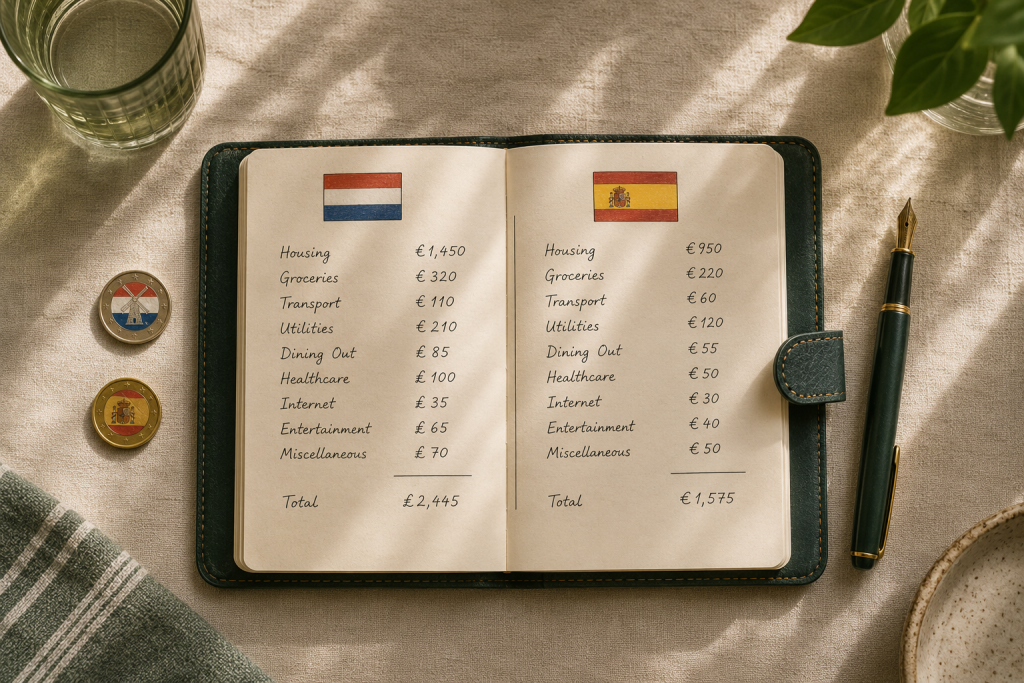


Living in Spain is on average 30–45% cheaper than living in the Netherlands for a typical family or retiree. The largest deltas are healthcare (Dutch mandatory health insurance costs €140–€160 per adult per month — Spain has structurally cheaper options), utilities and heating (Dutch gas-heated homes run 50–70% more than Spanish equivalents), dining out (Spain is ~50% cheaper), and Box 3 wealth tax (which has no Spanish equivalent for most Comunidad Valenciana residents). Housing in the Randstad is materially more expensive than Valencia or the Costa Blanca; outside the Randstad the gap is smaller. Both countries use the euro — no FX risk — which is one of the reasons Dutch buyers move so decisively when they decide. Below is the full 2026 line-by-line breakdown with three worked examples.
The headline picture
For most Dutch relocators, the financial comparison is less dramatic than the UK or Scandinavian equivalents — but the lifestyle delta is larger. The Netherlands is well-organised, well-paid, and well-taxed. Spain is sunnier, slower, and structurally cheaper in the lines that matter most for daily life: healthcare costs, energy, eating out, and — for those with savings — wealth tax.
The short answer for most Dutch relocators to Valencia or the Costa Blanca:
- Amsterdam family of 4 → Valencia: ~35–45% lower total monthly living costs
- Utrecht / The Hague / Eindhoven family → Costa Blanca: ~25–35% lower total monthly living costs
- Dutch retiree couple → coastal Spain: ~30–40% lower total monthly living costs, plus material Box 3 relief
- Dutch HNW couple with substantial liquid assets: Box 3 saving alone often €5,000–€15,000+/year — sometimes the largest single financial driver
The categories driving the savings: healthcare, utilities, dining, childcare, Box 3 tax. The categories where the picture is mixed or unfavourable: housing in non-Randstad Dutch cities (Eindhoven, Groningen, Den Bosch) is broadly comparable to Valencia; new car prices are similar to slightly higher in Spain; Spanish income tax at high incomes is comparable to Dutch rates rather than meaningfully lower.
Housing — Randstad vs Valencia and Costa Blanca
Renting
Indicative monthly rent, 3-bedroom apartment, family-suitable area, 2026:
| Location | Monthly rent |
|---|---|
| Amsterdam — central canal belt / De Pijp / Oud-Zuid | €2,800–€4,200 |
| Amsterdam — Zuidas / Oost / outer rings | €2,000–€2,800 |
| Utrecht — central / Lombok / Oost | €1,800–€2,800 |
| The Hague — Statenkwartier / Benoordenhout | €1,900–€2,800 |
| Rotterdam — Kralingen / centrum | €1,600–€2,400 |
| Eindhoven — central good area | €1,500–€2,200 |
| Smaller cities (Den Bosch, Breda, Groningen) | €1,200–€1,800 |
| Valencia — Eixample (premium central) | €1,400–€2,000 |
| Valencia — Pla del Real (premium residential) | €1,800–€2,800 |
| Valencia — Ruzafa / El Carmen (lively central) | €1,200–€1,800 |
| Valencia — outer (L’Eliana, Patacona, Alboraya) | €900–€1,400 |
| Jávea / Altea / Moraira — quality residential | €1,200–€2,000 |
| Calpe / Dénia — coastal apartment | €900–€1,500 |
Central Amsterdam rent is roughly 1.6–2.2× central Valencia rent for comparable family apartments. Once you leave the Randstad — into Eindhoven or smaller Dutch cities — the gap narrows substantially, and a 3-bedroom apartment in Eindhoven costs roughly the same as Valencia Eixample. The Costa Blanca premium towns (Jávea, Moraira, Altea) run €1,200–€2,000 for quality 3-bedroom rentals — broadly comparable to Utrecht or The Hague residential pricing.
Buying
Average asking prices per square metre, 2025–2026:
- Amsterdam (city average): €6,500–€9,000/m²; prime central €10,000–€14,000/m²
- Utrecht: €5,500–€6,800/m²
- The Hague: €5,000–€6,000/m²
- Rotterdam: €4,200–€5,200/m²
- Eindhoven / Breda: €4,000–€5,000/m²
- Smaller Dutch cities: €3,500–€4,800/m²
- Valencia city centre (Eixample, Pla del Real): €2,800–€4,500/m²
- Valencia outer residential: €1,800–€2,400/m²
- Costa Blanca quality coastal (Altea, Jávea, Moraira): €3,200–€5,500/m²
- Costa Blanca premium villa zones: €4,500–€7,500/m²
A 100m² family apartment: €650K–€900K in central Amsterdam vs €350K–€450K in central Valencia. For full property purchase context including all taxes and fees, see our cost-of-buying breakdown.
Property tax — OZB and friends vs IBI
This is the category where the Spain-cheaper narrative is least dramatic. Both countries have municipal property taxes; the structures differ:
| Property profile | Netherlands annual | Spain annual |
|---|---|---|
| OZB / IBI on the property itself | €200–€800 (varies wildly by municipality) | €450–€1,200 |
| Afvalstoffenheffing (waste) | €250–€450 | €100–€220 (basura) |
| Rioolheffing (sewerage) | €150–€300 | included in water bill |
| Watersysteemheffing (water board) | €250–€400 | n/a |
| Total typical annual | €850–€1,950 | €600–€1,400 |
Dutch OZB rates vary dramatically by municipality — Amsterdam’s OZB rate is among the lowest in the country (~0.04% of WOZ value) while Rotterdam’s is among the highest (~0.13%). The Dutch system is layered with multiple smaller taxes (waste, sewerage, water board) that together add up to a meaningful annual figure. Spanish IBI is simpler — one number, paid annually or biannually, plus a modest basura charge.
Net difference: typically €300–€800/year cheaper in Spain for an equivalent family home — meaningful but not transformational. For deeper detail on Spanish ownership costs, see our annual ownership costs guide.
Utilities — where Spain wins decisively
This is the second-largest delta after housing, and it’s structural: Dutch homes are heated by natural gas through cold, dark winters, and Dutch energy prices have remained elevated since the 2022 gas-supply shock. Spanish homes use less heating, more efficient cooling, and cheaper electricity per unit.
| Service | Netherlands monthly | Spain monthly |
|---|---|---|
| Electricity + gas (90m² family apartment, winter avg) | €220–€380 | €90–€170 |
| Water | €25–€40 | €15–€30 |
| Internet (fibre 300+ Mbps) | €45–€70 | €25–€40 |
| Mobile (4 SIMs, family plan) | €50–€90 | €25–€55 |
| TV / streaming bundle | €15–€30 | €10–€25 (optional) |
| Total monthly | €355–€610 | €165–€320 |
| Total annual | €4,260–€7,320 | €1,980–€3,840 |
Dutch utilities run roughly 50–60% more than Spanish equivalents, with the biggest gap in winter energy costs. A Dutch family heating a typical 100m² apartment from October through April spends €1,200–€2,500/year on gas alone. The Spanish equivalent — heating from December through February only, in milder coastal climates — is €200–€500/year.
The inverse: Spanish summers require air conditioning from June through September on the coast, adding €30–€80/month to summer electricity bills. Net annual energy use is still meaningfully lower in Spain because the heating burden is the larger contributor.
Groceries — Dutch supermarket habits in Spain
Dutch families relocating to Spain quickly discover that the Albert Heijn / Jumbo / Plus weekly basket maps reasonably well to Mercadona, Consum, and Carrefour, with the major differences being fresh produce, olive oil, and wine. Indicative basket comparison, 2026:
| Item | Netherlands | Spain |
|---|---|---|
| 1L semi-skimmed milk | €1.20 | €1.10 |
| 1kg chicken breast | €8.50 | €6.80 |
| 1kg tomatoes | €3.20 | €1.80 |
| 1kg apples | €2.50 | €1.80 |
| 500g bread (loaf) | €2.20 | €1.10 |
| 1L olive oil (mid-tier) | €8.50 | €5.50 |
| Bottle of decent table wine | €7.50 | €4.50 |
| Pack of 6 eggs | €2.30 | €1.70 |
| 1kg cheese (medium-aged) | €13.00 | €11.00 |
| 1kg fresh fish (mid-market) | €18.00 | €12.00 |
Family-of-four monthly groceries typically run €700–€950 in the Netherlands versus €450–€650 in Spain — roughly 30–35% cheaper. The biggest differences are in fresh produce, olive oil, fish, and wine. Dutch specialty items (Hagelslag, Stroopwafels, vla, certain cheeses) are available in Spain at Dutch shops in Costa Blanca expat communities — usually at 1.5–2× Dutch prices.
Dining out
| Item | Netherlands | Spain |
|---|---|---|
| Café coffee (cappuccino) | €3.50–€4.50 | €1.80–€2.50 |
| Pint of beer / caña | €5.00–€6.50 | €2.00–€3.20 |
| Glass of house wine | €5.00–€7.50 | €2.50–€4.00 |
| Lunch deal / dagschotel (Spain: menú del día) | €15–€25 | €13–€18 |
| Dinner for 2 at a casual restaurant | €65–€95 | €35–€55 |
| Quality dinner per head (mid-range) | €60–€95 | €40–€70 |
| Tasting menu at a good restaurant | €75–€140 per head | €55–€95 per head |
This is where day-to-day quality of life shifts most. A Dutch couple eating out twice a month in the Netherlands can comfortably eat out four to six times a month in Valencia for the same monthly spend. The Spanish menú del día — a fixed-price weekday lunch including starter, main, drink, bread, and often coffee or dessert for €13–€18 — has no real Dutch equivalent and becomes a Spanish lifestyle staple for most relocators within months.
Transport — bikes vs cars
Dutch transport patterns translate poorly to Spain. The Netherlands is built for cycling and integrated public transport; the Costa Blanca is car-dependent, and Valencia is increasingly bike-friendly but smaller in scale than Amsterdam or Utrecht.
Car ownership
| Item | Netherlands | Spain |
|---|---|---|
| Petrol per litre | €2.00–€2.15 | €1.50–€1.65 |
| Diesel per litre | €1.75–€1.90 | €1.45–€1.60 |
| Annual road tax (MRB / IVTM) | €450–€900 (varies by weight + region) | €60–€220 |
| Car insurance — family hatchback | €700–€1,200/year | €350–€650/year |
| Parking permit (urban resident) | €60–€500/year (Amsterdam can be much higher) | €0–€150/year (where applicable) |
| APK / ITV inspection (annual) | €45 | €40 |
Dutch fuel is the most expensive in Europe; Spanish fuel is mid-European. Dutch road tax (motorrijtuigenbelasting) scales with vehicle weight and is heavier than the Spanish equivalent (IVTM, which scales with horsepower / fiscal classification). Net annual cost of running a family car: typically €4,500–€6,500 in the Netherlands vs €2,500–€3,800 in Spain.
The other side: most Dutch families in the Netherlands rely heavily on bikes and public transport, materially reducing the practical need for two cars. On the Costa Blanca, two cars are usually necessary for a family. In central Valencia, one car plus bikes plus public transport works well — closer to the Dutch model.
Public transport
- Amsterdam GVB monthly pass: €100–€150
- NS train (Amsterdam → Utrecht single): €8.40
- Valencia integrated monthly pass (metro + bus): €40 (most zones), €50 (all zones)
- Renfe regional train (Valencia → Castellón single): €5.50
Spanish urban public transport is roughly 50–60% cheaper. Spanish intercity rail (AVE high-speed) is broadly comparable in price to NS Hispeed equivalents — sometimes cheaper, sometimes not.
Healthcare — where Spain saves the most for Dutch relocators
This is the single largest structural difference and the most underestimated category for Dutch families and retirees considering relocation.
The Netherlands has a mandatory private health insurance system (basisverzekering). Every Dutch resident must hold a basic policy from one of several private insurers — Zilveren Kruis, VGZ, CZ, Menzis, etc. — and pay the full premium plus an annual deductible (eigen risico) before insurance covers anything.
| Profile | Netherlands annual | Spain annual |
|---|---|---|
| Adult basisverzekering premium | €1,680–€1,920 | n/a (free if working/SS contributor) |
| Annual eigen risico per adult | €385–€885 (chosen) | n/a |
| Aanvullende verzekering (top-up, dental etc.) | €300–€800 | not equivalent — Spanish public covers most |
| Children under 18 | Free (covered by parent) | Free |
| Family of 2 adults + 2 children annual | €4,200–€5,800 | €0 (if working/SS contributor) or €1,500–€3,500 (private if NLV holder) |
Spanish healthcare structure for Dutch relocators:
- Working in Spain (employee or autónomo): Free public healthcare via Seguridad Social contributions. No premium. No deductible.
- Retiree with Dutch state pension (AOW): Apply for an S1 form through the SVB (Sociale Verzekeringsbank). With S1, you access full Spanish public healthcare paid for by the Netherlands government. No premium in Spain. This is the single most valuable benefit for retiree relocators.
- Non-working resident (NLV holder, not yet retired): Private health insurance is the residency requirement. Sanitas, DKV, Adeslas family plans typically €100–€180/month for a couple, €140–€240/month for a family of four. Substantially cheaper than Dutch basisverzekering and with no deductible structure.
For a Dutch family of four moving to Spain as working residents: healthcare cost drops from ~€4,800/year to ~€0. For a Dutch retiree couple with S1 forms: same drop. For a Dutch NLV-route relocator family: ~€4,800 to ~€2,400/year — still a meaningful 50% saving.
Education and childcare — the family case
Education
For full school-fee detail in Spain, see our international schools guide. Headline Netherlands vs Spain:
| Option | Netherlands annual | Spain annual |
|---|---|---|
| State school (basisschool / middelbare school) | Free (€50–€300 voluntary contribution) | Free (€100–€400 indirect) |
| State + extra programmes / concertado | n/a | €500–€3,000 |
| Private bilingual / international primary | €8,000–€14,000 | €5,500–€10,000 |
| International school (full British / IB / American) | €18,000–€32,000 | €7,500–€15,000 |
International school costs in Spain run roughly 40–55% lower than equivalent Dutch international schools (American School of The Hague, British School in The Netherlands, International School of Amsterdam). For Dutch families currently in private or international Dutch schools, the saving is material.
One important note for Dutch families: the Spanish public school system is structurally similar to the Dutch system and many Dutch families settle their children into Spanish state or concertado schools without major friction, especially under age 10. Spanish public schooling is genuinely free, the quality varies by school but is broadly comparable to Dutch state schooling, and Dutch children typically pick up Spanish in 12–18 months. This is a route that works well for families committed to multi-year Spanish residence.
Childcare — the biggest family saving
Dutch childcare is among the most expensive in Europe. Spanish childcare is among the cheapest in Western Europe. This is one of the largest financial deltas for families with young children:
| Service | Netherlands | Spain |
|---|---|---|
| Kinderopvang (under 4, full-time) | €1,500–€2,200/month gross | €280–€450/month (guardería) |
| After kinderopvangtoeslag (subsidy) | Effective €400–€1,200/month depending on income | n/a — base price already low |
| School-age after-school care (BSO) | €400–€700/month per child | €60–€150/month per child |
| Summer holiday programmes (6 weeks) | €1,200–€2,400 | €350–€800 |
For a Dutch family with two children under 4 in kinderopvang, gross annual cost of €36,000–€48,000 before subsidy is common. After kinderopvangtoeslag, families typically pay €8,000–€20,000 net depending on income. The same family in Spain pays €6,000–€10,000 gross with no subsidy needed — and the Spanish guardería is full-time with similar hours to Dutch kinderopvang.
Income tax and Box 3 — where the picture gets nuanced
Box 1 — employment income
Dutch Box 1 brackets, 2025:
- Up to €38,441: 35.82% (combined income tax + premium volksverzekeringen)
- €38,441–€76,817: 36.93%
- Above €76,817: 49.5%
Spanish income tax (national + Comunidad Valenciana combined, indicative):
- Up to €12,450: ~19%
- €12,450–€20,200: ~24%
- €20,200–€35,200: ~30%
- €35,200–€60,000: ~37%
- €60,000–€300,000: ~45%
- Over €300,000: ~47%
Net take-home comparison, single earner, 2025–2026:
| Gross income | Netherlands net | Spain net (no Beckham) | Spain net (with Beckham) |
|---|---|---|---|
| €40,000 | ~€30,200 | ~€30,400 | ~€30,400 |
| €60,000 | ~€42,200 | ~€42,800 | ~€45,600 |
| €100,000 | ~€62,500 | ~€64,500 | ~€76,000 |
| €150,000 | ~€86,000 | ~€90,000 | ~€114,000 |
| €250,000 | ~€137,000 | ~€144,000 | ~€190,000 |
Pure Box 1 income tax is broadly comparable between the two countries at middle incomes. Spain becomes meaningfully more favourable at higher incomes only when the Beckham Law applies — a flat 24% on Spanish-source income up to €600,000, available for 6 years to new tax residents who haven’t been Spanish tax-resident in the previous 5 years.
For Dutch tech, finance, or consulting professionals relocating to Spain at €100,000+ Spanish salary, the Beckham regime is the single most valuable financial structure. See our NLV vs Digital Nomad Visa guide for full detail on eligibility.
Box 3 — the wealth tax that has no Spanish equivalent
This is the line that drives many Dutch retirees and high-net-worth families to Spain.
The Netherlands taxes wealth held in savings, investments, and second homes through Box 3. For 2025–2026, the tax-free allowance is around €57,684 per person (€115,368 per couple). Above that, the system taxes a calculated return on assets at approximately 36%.
Practical examples of annual Box 3 tax burden (single individual, 2026 indicative):
- €200,000 in liquid investments: ~€2,000–€4,500 Box 3 tax per year
- €500,000 in liquid investments: ~€6,000–€13,500 Box 3 tax per year
- €1,000,000 in liquid investments: ~€14,000–€30,000 Box 3 tax per year
- €2,000,000 in liquid investments: ~€30,000–€60,000 Box 3 tax per year
(Exact figures depend on the asset mix — savings, bonds, equities — and the current notional/actual return regime, which has been under revision since 2021 and continues to evolve.)
Spanish equivalents for Comunidad Valenciana residents:
- Wealth tax (Impuesto sobre el Patrimonio): Comunidad Valenciana applies its own regional schedule. Threshold €500,000 per person of net Spanish assets, with a €300,000 main-home exemption. Progressive brackets above. Many configurations below ~€1M Spanish net wealth result in modest or zero practical liability.
- Solidarity Tax on Large Fortunes: National-level, applies only above €3,000,000 net wealth. For most Dutch relocators below that threshold, not in scope.
- Income tax on actual investment income: 19–28% on dividends and capital gains realised. Lower than Dutch Box 3 effective rate for most asset compositions.
For a Dutch couple with €750,000 in liquid investments moving to Spain (Comunidad Valenciana resident): Box 3 burden drops from ~€10,000–€18,000/year to typically €2,000–€5,000/year on actual investment income. For couples with €1.5M+ in liquid assets, the annual saving frequently exceeds €15,000.
This single line is, for many Dutch HNW retirees, the largest financial driver of the relocation decision — larger than housing, utilities, and dining combined.
VAT (BTW vs IVA)
Headline VAT rates are similar but applied differently:
- Netherlands BTW: 21% standard, 9% reduced (food, books, public transport, hairdressers)
- Spain IVA: 21% standard, 10% reduced (food in restaurants, transport, hotels), 4% super-reduced (basic food, books, medicines)
The Spanish super-reduced rate of 4% on basic food and books gives Spain a small but real advantage on essentials. Net effect on a typical household: roughly comparable, with Spain slightly cheaper on basics and the Netherlands slightly cheaper on certain prepared food categories.
Worked example 1 — Amsterdam family of 4 to Valencia
Dutch family relocating from Amsterdam (Oost / Watergraafsmeer area) to central Valencia. Two children aged 6 and 9, both into a Spanish concertado school (recommended for under-10s with multi-year Spain horizon). One car, plus bikes and public transport. Both parents work — one Dutch remote employer (declared in Spain), one moves to Spanish employment with Beckham regime application.
| Category | Amsterdam annual | Valencia annual |
|---|---|---|
| Rent (3-bed apartment, family area) | €33,600 | €20,400 |
| Municipal property taxes (OZB / IBI plus auxiliaries) | €1,400 | €700 |
| Utilities (electricity, gas, water, internet, mobile) | €5,200 | €2,400 |
| Groceries | €10,200 | €6,600 |
| School + after-school (2 children, concertado + BSO equivalent) | €12,000 (BSO + indirect) | €2,400 (concertado fees + extras) |
| Healthcare (basisverzekering both adults + top-up + eigen risico vs Spanish public) | €5,200 | €0 (working SS) |
| Transport (1 car + bikes + occasional public) | €4,400 | €3,200 |
| Dining out + leisure | €6,200 | €4,400 |
| Other (clothing, household, travel, misc) | €7,200 | €5,500 |
| Total annual | ~€85,400 | ~€45,600 |
Net annual saving: ~€39,800 — roughly 47% lower total living costs. The largest single contributors: rent, healthcare, school/childcare. The Beckham regime applied to the partner on Spanish employment adds further net-of-tax improvement on the income side, not reflected in this table.
Worked example 2 — Utrecht family of 4 to Costa Blanca (Jávea)
Dutch family relocating from Utrecht (Lombok area) to Jávea. Two children aged 8 and 11, into a mid-tier British international school (Lady Elizabeth or Xabia International). One income — Dutch remote employment, declared in Spain via Digital Nomad Visa with Beckham regime. Two cars (Costa Blanca living is more car-dependent than central Utrecht).
| Category | Utrecht annual | Jávea annual |
|---|---|---|
| Rent (3-bed family home) | €26,400 | €18,000 |
| Municipal property taxes | €1,300 | €800 |
| Utilities | €4,800 | €2,700 |
| Groceries | €9,600 | €6,000 |
| School fees (2 children — equivalent Dutch international vs Spanish int’l) | €36,000 (Dutch international) | €20,000 (mid-tier Spanish int’l) |
| Healthcare (basisverzekering 2 adults + eigen risico vs Spanish public via DNV) | €5,200 | €0 (DNV → SS coverage) |
| Transport (1 car + bikes vs 2 cars in Jávea) | €4,200 | €5,200 |
| Dining out + leisure | €5,500 | €3,800 |
| Other | €6,800 | €5,000 |
| Total annual | ~€99,800 | ~€61,500 |
Net annual saving: ~€38,300 — roughly 38% lower. Note that transport actually increases slightly in Spain due to two-car requirement on the Costa Blanca; the saving comes from rent, schools, healthcare, and dining. School costs are particularly significant here — Dutch international schools at €18,000/child/year vs Spanish international at €10,000/child/year is a €16,000/year delta on two children alone.
Worked example 3 — Dutch retiree couple with €600K savings to coastal Spain
Retired Dutch couple, both 67, moving from a Brabant village to a coastal Costa Blanca town (Calpe / Dénia / Altea). Both eligible for AOW and S1 forms. One car. Own their Dutch home (renting it out post-relocation) and purchase a Spanish apartment outright. €600,000 in liquid investments above the Box 3 threshold.
| Category | Netherlands annual | Spain annual |
|---|---|---|
| Home maintenance / service charges | €3,200 | €2,400 (community fees) |
| Municipal property taxes | €1,300 | €700 |
| Utilities | €4,200 | €1,900 |
| Groceries | €6,500 | €4,500 |
| Transport (1 car) | €3,800 | €2,500 |
| Healthcare | €4,400 (basisverzekering + top-up + eigen risico) | €0 (S1 form + €600 dental/specialist) |
| Dining out + leisure | €4,200 | €3,200 |
| Other (travel, household, gifts) | €5,800 | €4,400 |
| Box 3 tax on €600K investments (above threshold) | ~€8,500 | ~€2,200 (actual income tax on investment income) |
| Non-resident tax / Modelo 210 | n/a | n/a (already resident) |
| Total annual | ~€41,900 | ~€21,800 |
Net annual saving: ~€20,100 — roughly 48% lower. The Box 3 saving alone is ~€6,300/year and grows with the asset base. For a couple with €1.5M in liquid investments, the Box 3 saving alone often crosses €15,000/year.
What costs more in Spain
To be honest about the picture, some categories do run higher in Spain or are roughly equivalent:
- Income tax at €50K–€100K Spanish-source without Beckham. Roughly comparable to Dutch Box 1 — Spain offers no clear net advantage without the Beckham regime.
- Dutch supermarket specialty products. Hagelslag, vla, drop, Stroopwafels, specific Dutch cheeses — available at Dutch shops in expat areas but at 1.5–2× Dutch retail prices.
- Quality of public services in some categories. Dutch public administration is generally faster and more digital than Spanish. Bureaucracy — NIE, padrón, residency, banking — takes longer in Spain, particularly outside major cities.
- Some imported goods. Books in Dutch, certain electronics, specific brands. Internet shopping mitigates most of this.
- Property purchase taxes for new builds. 10% IVA + 1.5% AJD = 11.5% in Valencia/Costa Blanca, broadly comparable to Dutch overdrachtsbelasting (overdrachtsbelasting is 2% for personal-use property, 10.4% for investment property as of 2026). For a personal home, Dutch overdrachtsbelasting is actually substantially cheaper.
- New cars in some segments. Broadly similar with some segments slightly higher in Spain.
Climate and lifestyle — the unstated half of the equation
For Dutch relocators, the cost-of-living gap is rarely the decisive factor on its own. The lifestyle and climate delta is what makes the move happen. Numbers worth noting:
- Sunshine hours/year: Valencia ~2,700; Costa Blanca ~3,000; Amsterdam ~1,650; Utrecht ~1,600
- Average winter daytime temperature: Valencia 16°C; Altea 17°C; Amsterdam 6°C; Utrecht 5°C
- Annual rainfall: Valencia ~450mm; Costa Blanca ~370mm; Amsterdam ~830mm; Utrecht ~810mm
- Daylight hours in December: Valencia 9.5h; Amsterdam 7.7h
For families considering the move primarily for quality of life — light, outdoor living, mediterranean climate, slower pace — the financial saving is the accelerator, not the reason. For HNW retirees with substantial Box 3 exposure, the financial saving is sometimes large enough to be the primary driver on its own.
Common mistakes Dutch relocators make
- Comparing only rent and missing the healthcare delta. Dutch basisverzekering at €4,200–€5,800/year for a family is invisible in most cost-of-living spreadsheets and is one of the biggest single savings in the move.
- Underestimating Box 3 relief. For couples with substantial liquid wealth, Box 3 alone often saves €8,000–€20,000+/year. Worth modelling explicitly.
- Missing the S1 form (retirees). Dutch state pensioners are entitled to apply for S1 via SVB and access Spanish public healthcare paid for by the Netherlands. Many retirees buy private Spanish health insurance unnecessarily because they don’t know.
- Choosing the wrong residency route. NLV requires private health insurance; DNV gives Seguridad Social access plus potential Beckham. The right route depends on whether you’re working, retired, or living on capital.
- Overlooking the Beckham regime. For Dutch professionals with €80K+ Spanish-source income (employment or DNV-eligible self-employment), Beckham saves €15,000–€40,000+/year. Apply within 6 months of becoming Spanish tax-resident.
- Underestimating two-car necessity on Costa Blanca. Dutch families used to one car plus bikes find Costa Blanca life requires two cars in most non-central locations.
- Forgetting AOW currency and tax treatment. AOW is paid in euros into a Dutch or Spanish bank account; under the Netherlands–Spain double tax treaty, AOW is taxed in the Netherlands (article 19), private Dutch pensions taxed in Spain (article 18) above a small threshold. Sequence of pension drawdowns and timing of relocation matters.
How a boutique advisor helps here
The Dutch financial profile is more complex than most relocation comparisons capture. Box 3, AOW, private workplace pensions, the 30% ruling timing, double-tax treaty articles, S1 form eligibility — each of these has tax and timing implications that compound. A good advisor walks the family through the sequence: when to formally relocate, when to take pension drawdowns, when to sell or hold Dutch property, when to apply for Beckham or DNV. Get the sequence right and the financial saving compounds; get it wrong and a chunk of it is given back to one tax authority or the other.
That is the work we do — alongside the property side. Selective by design: we represent the buyer, not the listing.
FAQ
Is Spain cheaper than the Netherlands?
Yes — for most Dutch families and retirees, Spain is 30–45% cheaper for total cost of living. The largest savings are in healthcare (Dutch mandatory insurance costs €4,200–€5,800/year for a family vs €0 in Spain for working residents), utilities (Spain ~50% cheaper), dining out (Spain ~50% cheaper), and childcare (Spain ~70% cheaper). For Dutch with substantial savings, Box 3 relief adds further material savings.
How much money do I need to live comfortably in Spain compared to the Netherlands?
For a comfortable family of four lifestyle in Valencia or the Costa Blanca, plan €45,000–€65,000/year. The Dutch equivalent lifestyle costs roughly €80,000–€110,000/year. A Dutch retiree couple lives comfortably on €22,000–€32,000/year in coastal Spain vs €38,000–€48,000/year in equivalent Dutch locations.
Is Valencia cheaper than Amsterdam?
Substantially — typically 40–50% cheaper on total monthly living costs. The largest delta is housing (€1,400–€2,000 vs €2,800–€4,200 for a 3-bedroom apartment) and healthcare. Both use the euro, so there is no currency risk.
What’s cheaper in Spain than the Netherlands?
Healthcare (no mandatory €140+/month insurance), housing (especially vs Randstad), utilities and heating, dining out, alcohol, coffee, fresh produce, olive oil, wine, public transport, childcare, private schooling, and — for those with significant savings — wealth tax relief via the absence of Box 3 for Comunidad Valenciana residents.
What’s more expensive in Spain than the Netherlands?
Spanish supermarkets stocking Dutch products (Hagelslag, vla, drop), specific Dutch services, the speed of bureaucratic processes (Dutch admin is faster), property purchase tax for personal use (Dutch overdrachtsbelasting at 2% vs Spanish ITP/IVA at 10–11.5%), and income tax at €50K–€100K Spanish-source income without the Beckham regime.
Do I keep AOW if I move to Spain?
Yes. AOW (Dutch state pension) is paid to recipients regardless of residence, including in Spain. Under the Netherlands–Spain double tax treaty, AOW remains taxable in the Netherlands. Private Dutch workplace pensions are taxed in Spain when paid to a Spanish tax resident (above modest thresholds).
What is the S1 form for Dutch retirees in Spain?
The S1 form is a European cross-border healthcare entitlement. Dutch retirees receiving AOW can apply for S1 through the SVB (Sociale Verzekeringsbank) and use it to access full Spanish public healthcare paid for by the Netherlands government. With S1, you do not need to pay Dutch basisverzekering and you do not need private Spanish insurance. This is the single most valuable benefit for retiree relocators.
How does Box 3 work if I move to Spain?
Once you become a Spanish tax resident, your Dutch Box 3 liability typically ends for the period you’re non-Dutch-resident — except for Dutch real estate, which remains Dutch-taxed as Dutch-situs property. Spanish equivalents are: wealth tax (Patrimonio) at €500K+ net Spanish assets with regional bonifications (Comunidad Valenciana applies its own regional schedule), and income tax on actual investment income at 19–28%. For most relocators below ~€1M liquid Spanish net wealth, the practical Spanish equivalent burden is materially lower than Dutch Box 3.
Is healthcare really free in Spain for Dutch relocators?
It depends on your status. For Dutch citizens who become Spanish residents and work in Spain (employed or autónomo), Spanish public healthcare is free via Seguridad Social contributions. For retirees with AOW, the S1 form gives free public healthcare paid for by the Netherlands. For non-working residents (NLV holders), private health insurance is the residency requirement — typically €100–€180/month for a couple, €140–€240/month for a family. Still substantially cheaper than Dutch basisverzekering.
Can I work for a Dutch employer while living in Spain?
Yes, with the right structure. The Spanish Digital Nomad Visa (DNV) is designed specifically for this profile — you work for a non-Spanish employer (or as freelancer for non-Spanish clients) while becoming Spanish tax-resident. The DNV gives Seguridad Social access and potential Beckham regime eligibility. For most Dutch professionals earning €70,000+ from a Dutch employer, the DNV + Beckham combination produces materially better net outcomes than staying in the Netherlands. See our NLV vs DNV comparison for the detail.
Sources and further reading
For underlying data, useful for cross-checking your own scenario:
- Belastingdienst — Dutch tax authority, official income tax, Box 1/2/3 guidance
- Centraal Bureau voor de Statistiek (CBS) — Dutch national statistics, household expenditure, cost of living
- Sociale Verzekeringsbank (SVB) — AOW and S1 form information
- Zorgwijzer — Dutch healthcare insurance comparison
- Agencia Tributaria — Spanish income tax, IVA, IRNR official guidance
- Instituto Nacional de Estadística (INE) — Spanish national statistics
- Eurostat — comparative European cost-of-living and price-level indices
- Netherlands–Spain double taxation treaty references — Belastingdienst international section
Where to start
For Dutch families and retirees considering Spain seriously, the right starting point is a clear-eyed budget mapped to your specific profile: family or retiree, working or living on capital, expected residency route, healthcare entitlement, Box 3 exposure. The arithmetic shapes the property search and the visa choice — not the other way round.
Read the Moving to Valencia expat guide · Read the cost-of-buying breakdown · Read the annual ownership costs guide · Read the NLV vs Digital Nomad Visa guide · Read the international schools guide · Get in touch.