
Buying Property in Altea, Spain: A Practical Guide for Serious Buyers
Buying Property in Altea, Spain: A Practical Guide for Serious Buyers
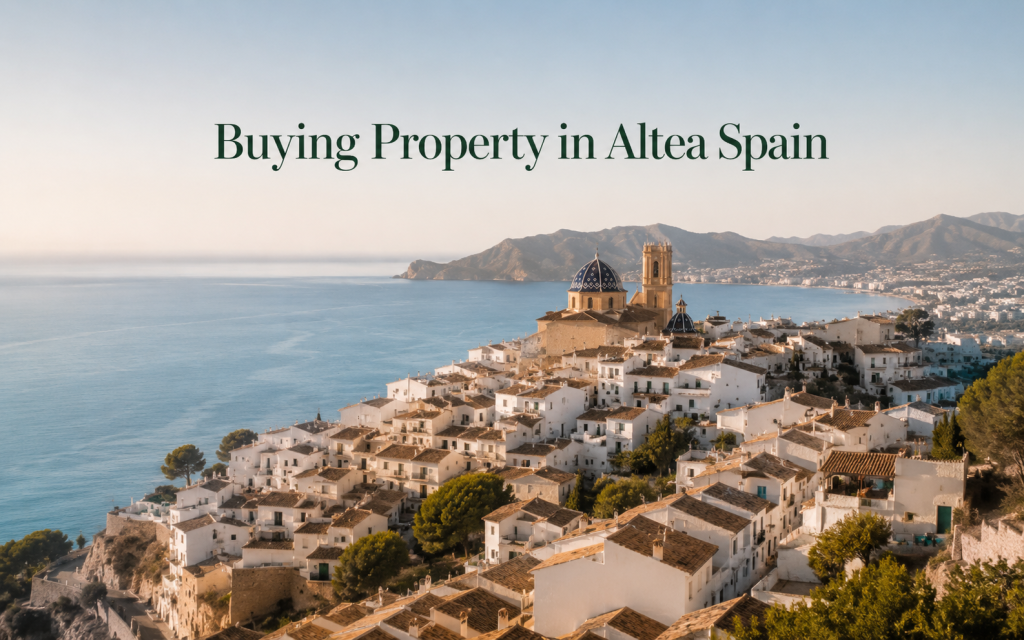
Altea is one of the few towns on the Costa Blanca that has managed to stay genuinely itself. The old village climbs steeply above the bay, its whitewashed lanes and blue-domed church unchanged for decades. Below it, a seafront promenade, a small marina, and some of the coast’s most considered residential architecture. For buyers who want the Costa Blanca without the noise, it remains the clearest choice.
What Altea offers that nearby towns don’t
Altea sits between Calpe and Benidorm but has little in common with either. There are no high-rises. The town has enforced strict height limits for decades, which has kept the skyline low and the character intact. The international community here – mostly Northern European, with a significant British presence and a growing number of buyers from Germany, the Netherlands, and Scandinavia – tends to be established, quiet, and long-term. This shapes the market: properties are held longer, turnover is lower, and quality tends to be higher than in more transactional resort towns.
The town also has year-round life. The arts community is active – Altea has long attracted painters and sculptors – and the restaurant scene is serious by Costa Blanca standards. If you plan to use a property outside July and August, Altea works in a way that purely seasonal towns don’t.
Neighbourhoods and price ranges
Altea old town (Casco Antiguo). The historic core on the hill. Stone townhouses and renovated village properties, most with terraces and sea views. Supply is very limited – owners rarely sell – and prices reflect it. Expect €400,000-€800,000+ for a well-restored house with views. These properties suit buyers who want character, walking access to the village, and a genuine sense of place.
Cap Negret and La Olla. The stretch of coastline south of the old town, where contemporary villas and larger homes sit directly above the sea. One of the most sought-after residential zones on the entire Costa Blanca. Prices range from €600,000 to well above €2M for front-line positions. These are primarily owner-occupied or long-term rental properties – not short-stay holiday stock.
Sierra de Altea and the upper hillside zones. Larger plots, more space, panoramic views over the bay. Modern villas from €350,000 upward, depending on build quality and proximity to services. Good value relative to the front-line positions, and popular with buyers who want privacy over proximity.
Altea Hills. A gated residential community above the town with its own sports facilities. Secure, well-maintained, and appealing to buyers who want a managed environment. A mix of apartments and detached villas; prices broadly from €250,000 for apartments to €700,000+ for larger villas.
The purchase process in Spain
Buying property in Spain as a foreign national is straightforward if you follow the correct sequence. The key steps:
NIE number. A Numero de Identificacion de Extranjero is required for any property transaction in Spain. You’ll need it before signing any purchase contract or opening a Spanish bank account. It can be obtained in Spain at a National Police station or through a Spanish consulate in your home country. Allow 2-4 weeks. See our separate guide on how to get your NIE in Spain.
Reservation contract (contrato de arras). Once you agree on a price, a reservation is signed and a deposit paid – typically 10% of the purchase price. This binds both parties: if the buyer withdraws, the deposit is forfeited; if the seller withdraws, they must return double.
Legal due diligence. Your Spanish solicitor will check the Land Registry, verify there are no outstanding debts or charges, confirm planning legality, and review community fees. Budget 1-1.5% of purchase price for legal fees.
Notary and completion. Final signing takes place before a Spanish Notary, who verifies identity and witnesses the transfer. The Title Deed (Escritura de Compraventa) is signed, funds are transferred, and keys change hands.
Taxes and purchase costs
Budget 10-13% on top of the purchase price for taxes and fees on a resale property in the Valencia region:
- ITP (transfer tax): 10% of the purchase price on resale properties in the Valencian Community. The largest additional cost.
- Notary and Land Registry fees: approximately 0.5-1% combined, depending on property value.
- Legal fees: typically 1-1.5% of purchase price.
- New build: ITP is replaced by VAT (IVA) at 10%, plus AJD stamp duty at 1.5%. Total cost burden is similar.
What to watch for in Altea specifically
Planning compliance. The hill zones and areas close to the old town have had some historical development on rural (rustico) land that may not have full planning retrospective certification. A good solicitor will flag any issues, but ask specifically. Properties in protected landscape zones may also have restrictions on extensions or outbuildings.
Community fees. In Altea Hills and other gated developments, fees can be significant – €2,000-€5,000 per year is not unusual. Factor this into running cost calculations before buying.
Rental liquidity. The Altea market is less liquid than Benidorm or Calpe for short-term holiday lets. If you are buying primarily as a short-term rental investment, Altea may not be the most efficient choice. If you are buying to use and to hold something worth more in ten years, the calculus looks quite different.
Access and off-market inventory
The Altea market rewards local knowledge. The best properties – particularly in the old town and the Cap Negret coastline – are rarely listed publicly. They circulate through trusted networks before reaching the open market, if they do at all. A boutique advisor with active relationships in the area will access inventory that a portal search simply won’t show.
reSELECTA works specifically in this part of the Costa Blanca. If you are considering a purchase in Altea, we are happy to discuss what is currently available and what fits your criteria.