
Cost of Living: UK vs Spain (2026) — Deep Comparison for Families and Retirees
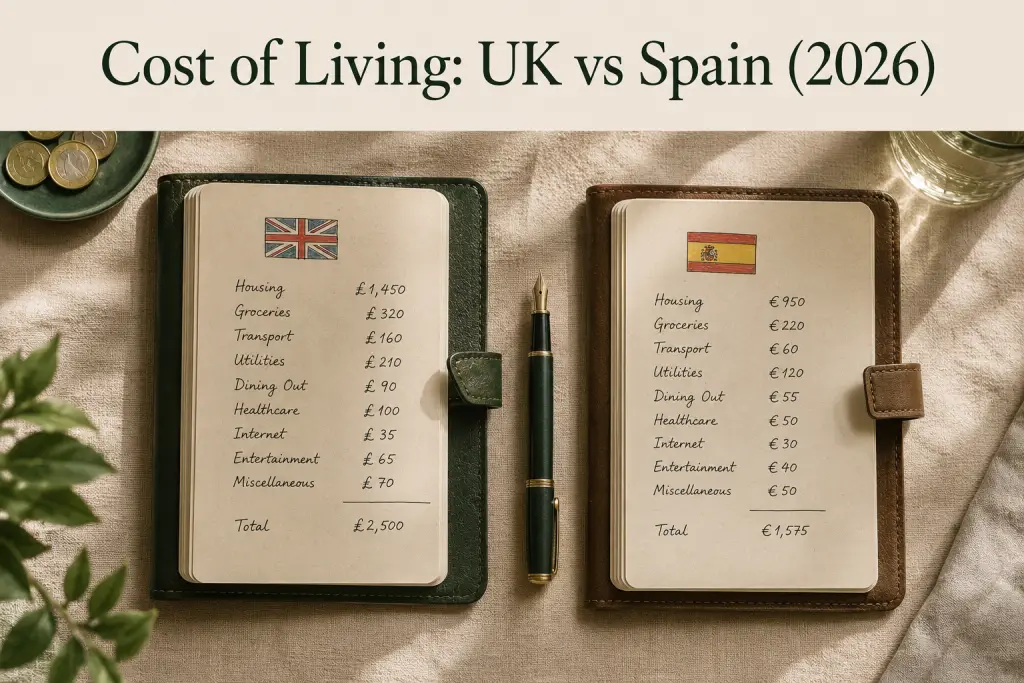


Living in Spain is on average 30–40% cheaper than living in the UK for a typical family or retiree. The largest single delta is housing (rent in Valencia is roughly half a comparable London property; outside London the gap narrows but stays material). Other meaningful savings come from utilities, dining out, public transport, and — for families — childcare, which is among the highest costs in the UK and one of the lowest in Spain. The picture inverts in only a few categories: income tax is generally higher in Spain, some imported goods cost more, and high earners on Spanish PAYE pay more than equivalent UK earners unless they qualify for the Beckham Law. Below is the full 2026 line-by-line breakdown with three worked examples.
The headline picture
If you’re a UK family or retiree thinking seriously about moving to Spain, the cost-of-living question is rarely abstract. You want to know how much money you’ll actually need each month, where the savings are real and where they aren’t, and whether your specific situation — kids in private school, car-dependent, two retirees, single earner on London salary — comes out ahead.
The short answer for most UK relocators to Valencia or the Costa Blanca:
- London family of 4 → Valencia: ~45–55% lower monthly living costs
- Manchester family of 4 → Costa Blanca: ~25–35% lower monthly living costs
- UK retiree couple → coastal Spain: ~30–40% lower monthly living costs
- High-earner relocator on Spanish PAYE without Beckham: small saving or even slight loss on net take-home — but with vastly better lifestyle and lower cost of family infrastructure
The categories that drive the savings: housing, childcare, utilities, dining, transport. The categories that work against you: income tax above ~€60,000 income, some imported groceries, premium private education at the top end.
Housing — the single biggest line
Renting
Indicative monthly rent, 3-bedroom apartment, family-suitable area, 2026:
| Location | Monthly rent |
|---|---|
| London — Zone 2–3 (Clapham, Wandsworth, Islington) | £2,500–£3,500 |
| London — Zone 3–4 (Wimbledon, Ealing, Greenwich) | £2,100–£2,800 |
| Manchester — desirable area (Didsbury, Chorlton) | £1,300–£1,700 |
| Bristol / Edinburgh — central good area | £1,500–£2,100 |
| Valencia — Eixample (premium central) | €1,400–€2,000 |
| Valencia — Pla del Real (premium residential) | €1,800–€2,800 |
| Valencia — Ruzafa / El Carmen (lively central) | €1,200–€1,800 |
| Valencia — outer (L’Eliana, Patacona, Alboraya) | €900–€1,400 |
| Jávea / Altea / Moraira — quality residential | €1,200–€2,000 |
| Orihuela Costa / Torrevieja — coastal apartment | €700–€1,200 |
A 3-bedroom apartment in central Valencia costs roughly the same as one in a mid-tier Manchester area, and roughly 40–55% of a comparable London Zone 2–3 property. The further you move from London, the smaller the gap. From Edinburgh or Bristol, Valencia central is roughly 20–30% cheaper. From Manchester, it’s roughly the same nominal price.
Buying
Average asking prices per square metre (2025–2026, market data):
- London (Greater London average): £6,000–£8,500/m²; prime central £15,000–£30,000/m²
- UK national average: £2,800–£3,300/m²
- Manchester / Birmingham / Leeds prime: £3,200–£4,200/m²
- Valencia city centre (Eixample, Pla del Real): €2,800–€4,500/m²
- Valencia outer residential: €1,800–€2,400/m²
- Costa Blanca quality coastal (Altea, Jávea, Moraira): €3,200–€5,500/m²
- Costa Blanca premium villa zones (Altea Hills, Cumbre del Sol): €4,500–€7,500/m²
A 100m² family apartment: £600K–£850K in London Zone 2–3 vs €350K–€450K in central Valencia. For property purchase context including all taxes and fees, see our cost-of-buying breakdown.
Property tax — Council Tax vs IBI
This is one of the largest hidden savings UK relocators discover:
| Property profile | UK annual | Spain annual (IBI) |
|---|---|---|
| 3-bed family apartment, mid-tier (Band D) | £2,000–£2,400 | €450–€800 |
| 4-bed family home, desirable area (Band E–F) | £2,400–£3,400 | €700–€1,500 |
| Premium home, prime area (Band G–H) | £3,400–£5,500 | €1,500–€3,500 |
UK Council Tax is roughly 2–4× higher than equivalent Spanish IBI. For a typical family home, the saving is £1,200–£1,800/year. For deeper detail on Spanish ownership costs, see our annual ownership costs guide.
Utilities — the second-biggest delta
Monthly indicative cost for a 90m² family apartment, family of four, 2026:
| Service | UK | Spain |
|---|---|---|
| Electricity + gas (combined) | £170–£260 | €90–€170 |
| Water + sewerage | £35–£55 | €15–€30 |
| Internet (fibre 300+ Mbps) | £28–£45 | €25–€40 |
| Mobile (4 SIMs, family plan) | £45–£90 | €25–€55 |
| TV licence | £14 | €0 (no equivalent) |
| Total monthly | £292–£464 | €155–€295 |
| Total annual | £3,500–£5,600 | €1,860–€3,540 |
Spanish utilities are roughly 40–50% cheaper than UK equivalents, with the biggest gap in mobile and gas/electricity. The TV licence (£169.50/year) has no Spanish equivalent — there’s no licensed broadcaster fee. One nuance worth noting: Spanish summers require air conditioning in coastal and southern locations, which adds €30–€80/month to electricity from June through September. UK winters require heating from October through April, which is the equivalent inverse cost. Net annual energy use is broadly similar; tariff per unit is materially lower in Spain.
Groceries — weekly basket
Indicative grocery basket (Mercadona / Carrefour / Consum in Spain; Tesco / Sainsbury’s / Morrisons in UK), 2026:
| Item | UK | Spain |
|---|---|---|
| 1L semi-skimmed milk | £1.45 | €1.10 |
| 1kg chicken breast | £7.50 | €6.80 |
| 1kg apples (mid-season) | £2.20 | €1.80 |
| 1kg tomatoes | £2.50 | €1.80 |
| 1kg potatoes | £1.10 | €1.10 |
| 500g pasta | £1.10 | €0.90 |
| 500g bread (loaf) | £1.30 | €1.10 |
| 1L olive oil (mid-tier) | £7.50 | €5.50 |
| Bottle of decent table wine | £8.00 | €4.50 |
| Pack of 6 eggs | £2.00 | €1.70 |
The basket-level difference is modest item-by-item but compounds. For a family of four, monthly groceries typically run £650–£900 in the UK versus €450–€650 in Spain — roughly 25–35% cheaper. Wine, olive oil, fresh produce, and seafood are where the gap is most visible. Imported British products (Marmite, baked beans, certain cheeses) are significantly more expensive in Spain when available — but most British relocators stop buying them within 6 months.
Dining out
| Item | UK | Spain |
|---|---|---|
| Cappuccino in a café | £3.50–£4.50 | €1.80–€2.50 |
| Pint of lager / caña | £5.50–£6.80 | €2.00–€3.20 |
| Glass of house wine | £5.50–£7.50 | €2.50–€4.00 |
| Menú del día / lunch deal (2 courses + drink) | £12–£18 | €13–€18 |
| Dinner for 2 at a casual neighbourhood restaurant | £55–£85 | €35–€55 |
| Tasting menu at a quality restaurant | £75–£150 per head | €55–€95 per head |
This is where the day-to-day quality of life difference is most felt. A British couple who would eat out once a fortnight in the UK can comfortably eat out twice a week in Valencia for the same monthly cost. The menú del día — a fixed-price lunch served in most neighbourhood restaurants — is a Spanish institution worth understanding: €13–€18 buys you a starter, main, drink, and coffee, usually with bread and sometimes dessert.
Transport
Car ownership
| Item | UK | Spain |
|---|---|---|
| Petrol per litre | £1.42–£1.55 | €1.50–€1.65 |
| Diesel per litre | £1.48–£1.62 | €1.45–€1.60 |
| Annual road tax (VED / IVTM) | £180–£600 (varies by emissions) | €60–€220 (varies by municipality) |
| Car insurance — family hatchback | £600–£1,100/year | €350–€650/year |
| Annual MOT / ITV inspection | £55 | €40 |
| Tolls (motorways) | Mostly free | Many free since 2019, some still tolled |
Fuel is roughly the same once GBP/EUR is normalised. The savings are in insurance (~40–50% cheaper in Spain) and annual road tax (~70% cheaper). On the Costa Blanca and around Valencia, almost all main routes are now toll-free since the AP-7 became free in January 2020.
Public transport
- London — Zones 1–3 monthly Travelcard: £197
- London — Zones 1–4 monthly: £242
- Manchester monthly TfGM: £80–£100
- Valencia — Metro + bus integrated monthly pass: €40 (most zones) — €50 (all zones)
- Madrid abono mensual (monthly pass, all zones, all transport): €54.60
Spanish urban public transport is materially cheaper. Valencia’s integrated transport pass at €40/month is roughly 20% of a London Zones 1–3 Travelcard. The system is also smaller in scale — but for most central residents, it covers what’s needed.
Healthcare
This is the category where the comparison is most often misunderstood. NHS healthcare is “free at point of use” but funded through National Insurance contributions. Spanish healthcare is structurally similar — free for residents who contribute to the Seguridad Social (working residents, employees, autónomos paying social security) — but operates differently for foreign residents:
| Profile | UK | Spain |
|---|---|---|
| Working resident with regular employment | Free NHS (funded by NI) | Free Seguridad Social healthcare (funded by SS contributions ~6.4% employee) |
| Self-employed | Free NHS (NI paid as Class 2 + 4) | €230–€650+/month autónomo SS — includes healthcare |
| Non-working resident (NLV holder) | n/a | Private health insurance required for residency: €60–€150/month |
| Retiree | Free NHS | UK retirees with S1 form: free Spanish public healthcare; otherwise private insurance €80–€180/month |
| Optional private top-up | £60–£150/month per family | €50–€140/month per family |
The S1 form is the key for British retirees. If you receive a UK state pension and move to Spain as a resident, the S1 form lets you access full Spanish public healthcare paid for by the UK government. This is the single most valuable benefit for retiree relocators — no insurance premium, full access to one of Europe’s strongest healthcare systems.
For working-age non-residents (NLV holders, those not working in Spain), private health insurance is a residency requirement. Sanitas, DKV, Adeslas, Mapfre, and Asisa offer family plans typically €100–€180/month for a couple, €140–€240/month for a family of four. Significantly cheaper than equivalent UK private cover.
Education
For full school-fee detail, see our international schools guide. Headline UK vs Spain:
| Option | UK annual | Spain annual |
|---|---|---|
| State school (primary / secondary) | Free (£300–£800 indirect costs) | Free (€100–€400 indirect costs) |
| State + voluntary contribution / concertado | n/a | €500–€3,000 |
| Private bilingual / colegio privado | n/a | €4,000–€7,000 |
| Day prep school / private day school | £15,000–£28,000 | €5,500–€10,000 (primary) |
| Major independent / international school | £25,000–£50,000 | €7,500–€15,000 |
Private and international education costs roughly 50–65% less in Spain for comparable quality. The international schools we cover in Valencia and the Costa Blanca deliver British curriculum (IGCSE / A-Levels) at €8,000–€13,000 per year for secondary — versus £20,000–£35,000 at equivalent UK day schools.
Childcare — the single biggest UK family cost
UK childcare is one of the highest costs in the OECD. Spain is among the lowest in Western Europe. This is the single largest delta for families with young children:
| Service | UK | Spain |
|---|---|---|
| Nursery / guardería (under 3, full-time) | £1,200–£1,800/month | €280–€450/month |
| Pre-school (3–5, full-time) | £900–£1,400/month (partly free entitlement) | €0 (free state pre-school from age 3) |
| After-school childcare | £250–£500/month per child | €60–€150/month per child |
| Summer holiday camps (6 weeks) | £1,200–£2,400 | €350–€800 |
For a UK family with two children under 5 in nursery, annual childcare costs of £25,000–£35,000 are common. The same family in Spain pays €6,000–€10,000. Multiply across the under-5 years and the difference can fund several years of mortgage payments outright.
Income tax and social security
This is the category where the UK is generally cheaper, particularly at middle and upper incomes. Indicative comparison, 2025–2026 tax year:
UK (England, 2025–2026)
- Personal allowance: £12,570
- Basic rate (20%): £12,570–£50,270
- Higher rate (40%): £50,270–£125,140
- Additional rate (45%): over £125,140
- National Insurance (employee): 8% on £12,570–£50,270, 2% above
- National Insurance (employer): 13.8% (not seen by employee but funds benefits)
Spain (national + Comunidad Valenciana, 2025–2026)
- Personal allowance: €5,550 + €2,400 work-related
- Combined national + regional brackets (Comunidad Valenciana, indicative):
- 0–€12,450: ~19%
- €12,450–€20,200: ~24%
- €20,200–€35,200: ~30%
- €35,200–€60,000: ~37%
- €60,000–€300,000: ~45%
- over €300,000: ~47%
- Seguridad Social (employee): ~6.4%
- Seguridad Social (employer): ~30%
Effective tax — single earner indicative
| Gross salary | UK net take-home | Spain net take-home |
|---|---|---|
| £35,000 / €40,500 | ~£28,400 | ~€30,800 |
| £50,000 / €58,000 | ~£38,800 | ~€41,800 |
| £80,000 / €92,000 | ~£57,700 | ~€60,200 |
| £120,000 / €138,500 | ~£77,400 | ~€84,500 |
| £200,000 / €230,000 | ~£123,400 | ~€131,500 |
At middle incomes (€30K–€60K), net take-home is roughly comparable after currency conversion. At higher incomes, the UK leaves more in your pocket — Spain’s marginal rates compound faster. For UK earners relocating with substantial income, the Beckham regime (a Spanish special tax regime for new tax residents) flat-taxes the first €600,000 of Spanish-source income at 24% for six years. Eligibility is specific (you must not have been a Spanish tax resident in the previous five years, and the income must be from a Spanish employer or self-employment activity), but where it applies, it makes Spain materially more tax-favourable than the UK for high earners.
For deeper detail on this and visa-route choices, see our NLV vs Digital Nomad Visa comparison.
VAT and consumer prices
Headline VAT rates are similar but applied differently:
- UK VAT: 20% standard, 5% reduced (energy, children’s car seats), 0% on most food, books, children’s clothes
- Spain IVA: 21% standard, 10% reduced (food in restaurants, public transport, hotels), 4% super-reduced (basic food, books, medicines)
The net effect: food and books are slightly more expensive in Spain at the VAT-line level (4–10% vs 0% UK) — but base prices are sufficiently lower that the absolute cost remains under the UK price for most categories. Energy is taxed more heavily in Spain (21% vs UK’s 5% reduced rate on domestic energy), which is one reason Spain’s electricity bills have closed the gap somewhat in recent years.
Worked example 1 — London family of 4 to Valencia
British family relocating from London Zone 3 to central Valencia. Two children aged 6 and 9, both into a mid-tier British international school. One car, public transport for the rest. Both parents work — one moves to Spanish employment, one keeps a remote UK contract (declared in Spain).
| Category | London annual | Valencia annual |
|---|---|---|
| Rent (3-bed apartment, family area) | £32,000 | €20,400 |
| Council tax / IBI | £2,200 | €600 |
| Utilities (electricity, gas, water, internet, mobile, TV) | £4,400 | €2,400 |
| Groceries | £10,200 | €6,600 |
| Childcare / after-school (2 children, public school) | £8,000 + £25,000 state school indirect / private alt | €1,800 (state school + light after-school) |
| Private school fees (if applicable, alternative) | £40,000+ | €20,000 (mid-tier British int’l, 2 kids) |
| Transport (1 car + occasional public) | £5,000 | €3,200 |
| Dining out + leisure | £6,500 | €4,400 |
| Healthcare top-up insurance | £1,200 | €1,800 |
| Other (clothing, household, travel, misc) | £8,000 | €5,500 |
| Total (state school option) | ~£77,500 | ~€46,700 (~£40,500) |
| Total (private/international school option) | ~£117,500 | ~€64,900 (~£56,400) |
Net annual saving: ~£37,000 (state) or ~£61,000 (private). The international-school option in Valencia delivers a comparable academic environment to a UK private day school at roughly half the all-in cost.
Worked example 2 — Manchester family of 4 to Costa Blanca
Family relocating from a desirable Manchester suburb to Jávea on the Costa Blanca. Two children aged 7 and 11, into a mid-tier British international school (Lady Elizabeth or Xabia International). One income — UK remote employment, declared in Spain. Two cars (Costa Blanca living is more car-dependent).
| Category | Manchester annual | Jávea annual |
|---|---|---|
| Rent (3-bed family home) | £18,000 | €18,000 |
| Council tax / IBI | £2,300 | €800 |
| Utilities (incl. higher summer AC) | £3,800 | €2,700 |
| Groceries | £9,000 | €6,000 |
| School fees (2 children, mid-tier int’l) | £25,000 (UK private day equiv.) | €20,000 |
| Transport (2 cars) | £6,500 | €4,800 |
| Dining out + leisure | £5,500 | €3,800 |
| Healthcare insurance | £1,500 | €2,000 |
| Other | £7,200 | €5,000 |
| Total | ~£78,800 | ~€63,100 (~£54,900) |
Net annual saving: ~£24,000. The gap narrows compared to the London example because Manchester rent and council tax are already relatively low, and Jávea’s school fees plus dual-car necessity offset some of the Spain advantages. The lifestyle delta — sea, climate, daily life — is where the move pays off beyond the spreadsheet.
Worked example 3 — UK retiree couple to coastal Spain
Retired couple, mid-60s, moving from a UK home county to a coastal Costa Blanca town (Altea / Dénia / Jávea). Both eligible for UK state pension and S1 form. One car. Own their UK home (renting it out post-relocation) and own their Spanish apartment outright.
| Category | UK annual | Spain annual |
|---|---|---|
| Home maintenance / service charges | £3,000 | €2,400 (community fees in apartment) |
| Council tax / IBI | £2,400 | €700 |
| Utilities | £3,400 | €1,900 |
| Groceries | £6,500 | €4,500 |
| Transport (1 car) | £3,200 | €2,200 |
| Healthcare | £0 (NHS) + £1,000 dental/specialist | €0 (S1 form) + €600 dental/specialist |
| Dining out + leisure | £3,800 | €3,200 |
| Other (travel, household, gifts) | £4,200 | €3,400 |
| Non-resident tax / Modelo 210 (Spanish property) | n/a | €350 (already a Spanish resident; n/a) |
| Total | ~£27,500 | ~€18,900 (~£16,400) |
Net annual saving: ~£11,000. The retiree case is dominated by housing fixed costs, utilities, and the S1-form healthcare benefit — the latter is genuinely transformational, giving full access to Spanish public healthcare paid for by the UK government with no premium.
What costs more in Spain
The Spain-cheaper picture is overall and average. Specific categories run the other way:
- Income tax above ~€60,000. Spanish marginal rates compound faster than UK rates at upper-middle and high income. Without the Beckham regime, a UK earner moving to Spanish PAYE on £100,000+ takes home slightly less in net terms after tax and social security.
- Imported British and American consumer products. Marmite, baked beans, specific cheeses, certain cereals, branded confectionery — 30–80% more expensive in Spain when available. Brexit has worsened this materially since 2021.
- New cars. Spanish car prices are broadly similar to the UK but in some segments slightly higher (especially diesel and lower-emission cars after Spain’s emissions-based purchase tax adjustment).
- Some electronics and white goods. Slightly more expensive in Spain than in the UK, where Amazon UK and competitive retail discounting are stronger.
- Domestic flights. UK domestic flights have been subsidised heavily by competitive low-cost carrier presence; Spanish domestic routes between major cities are often more expensive on like-for-like comparison.
- VAT on energy. Spain charges 21% IVA on domestic energy vs UK’s 5% reduced rate. Net Spanish electricity bills are still lower because the underlying tariff is lower, but the VAT element is heavier.
- Premium professional services. Lawyers, tax advisors, gestores — Spain is broadly comparable to UK rates, sometimes higher for English-speaking specialists serving the foreign-buyer market.
The income side — earning in Spain vs UK
Cost of living is half the equation; the other half is what you earn.
- Average UK salary: ~£37,000 (median full-time, 2025)
- Average Spain salary: ~€28,000 (median full-time, 2025)
- Average Valencia salary: ~€26,000
- Average Madrid / Barcelona salary: ~€32,000–€36,000
Nominal salaries are roughly 25–35% lower in Spain. After cost-of-living adjustment, the gap narrows substantially for most middle-income roles. However:
- Senior tech, finance, and consulting: UK salaries (especially London) are materially higher than Spanish equivalents. A senior software engineer in London earns 1.5–2.5× the Madrid equivalent in nominal terms.
- Remote UK roles paid in GBP: the holy grail. Earning UK salary while spending in Spain (declaring Spanish tax residence) typically produces 20–35% higher net disposable income after all costs, depending on tax structure.
- Spanish employment for foreign relocators: can be limiting unless the role is in the international/tourism/property sectors, or you’re senior at a multinational with a Spanish office.
Currency considerations
For UK relocators with GBP income or GBP-denominated assets:
- GBP/EUR rate matters. A 5% move in GBP/EUR shifts your effective Spanish purchasing power by 5%. Over a 12-month period that’s a real swing on a €60,000 cost base.
- Property purchase: consider forward contracts via a currency specialist (Wise, Currencies Direct) when you’ve committed to a purchase but haven’t yet completed.
- Monthly transfers: standing transfer at bank rate costs 2–4% in spread. Specialist providers cut this to 0.5–1%. On €5,000/month that’s €600–€1,500/year saved.
- Pension transfers: moving a UK pension to a QROPS scheme has tax implications. Worth a dedicated advisor conversation before relocation.
Common mistakes UK relocators make
- Comparing only rent and forgetting tax delta. Council tax savings alone are worth £1,200–£1,800/year for a typical family — easy to overlook in a spreadsheet that only compares rent figures.
- Underestimating utilities savings. Most UK families plan for similar utility costs; in practice Spanish utilities run 30–50% cheaper on equivalent property.
- Overlooking childcare arbitrage. For families with under-5s, this can be the single largest financial gain — far larger than housing.
- Assuming healthcare is “free” in Spain without checking residency category. S1 form works for UK pensioners. NLV holders need private insurance. Working residents qualify via Seguridad Social. Get this right before applying for residency.
- Forgetting the Beckham regime for high earners. If you’re moving with substantial Spanish-source income, the regime can save €15,000–€40,000+/year in tax. Apply within the first 6 months of becoming a Spanish tax resident.
- Not factoring in summer cooling costs. UK relocators tend to underestimate the air conditioning cost on the coast — €40–€80/month June–September. Modest, but real.
- Ignoring the FX risk window. Between deciding to move and actually moving, a 6–12 month FX swing can shift your effective budget by 5–10%. Plan for it.
How a boutique advisor helps here
Cost-of-living arithmetic is the easy part — anyone can compare Numbeo lines. The expensive parts are everything that doesn’t appear in those tables: structuring residency so you fall on the right side of the healthcare regime, timing your Spanish tax residency to optimise the Beckham window, choosing a property whose annual costs map to your specific profile, deciding whether your children’s schooling sits in the state, private, or international stream — and getting the FX and pension structure right before the first euro is moved.
That is the work we do. Selective by design: we represent the buyer, not the listing.
FAQ
Is Spain cheaper than the UK overall?
Yes — for most families and retirees, Spain is 30–40% cheaper for total cost of living. The biggest savings are in housing (especially vs London), childcare, utilities, dining out, and public transport. Income tax can be higher in Spain at upper-middle incomes, and some imported goods cost more. For high earners qualifying for the Beckham regime, Spain can also be tax-advantaged.
How much money do I need to live comfortably in Spain compared to the UK?
For a comfortable family of four lifestyle, plan around €40,000–€55,000/year net in Valencia (state school) or €60,000–€80,000/year net (international school). The UK equivalent lifestyle costs roughly £55,000–£90,000/year. A retiree couple lives comfortably on €25,000–€35,000/year in coastal Spain vs £30,000–£40,000/year in equivalent UK locations.
Is Valencia cheaper than London?
Substantially — typically 50–60% cheaper on total monthly cost of living. The largest delta is housing: a 3-bedroom apartment in central Valencia rents for €1,400–€2,000 vs £2,500–£3,500 in London Zone 2–3. Childcare and dining out are also dramatically cheaper. Income tax in Spain can be slightly higher for some incomes, but rarely enough to close the gap.
Is Valencia cheaper than Manchester?
Roughly comparable on housing — a 3-bedroom apartment in a desirable Manchester area (Didsbury, Chorlton) costs similar to central Valencia. Valencia comes out ~20–30% cheaper overall once utilities, council tax/IBI, childcare, transport, and dining are included. The lifestyle delta — climate, sea, daily life — is the larger driver of relocation decisions from Northern England than the pure cost-of-living gap.
What’s cheaper in Spain than the UK?
Housing (especially rent vs London), dining out, alcohol, coffee, fresh produce, olive oil, wine, mobile phone plans, public transport, car insurance, road tax, council tax/IBI, childcare, private schools, private healthcare, hairdressers, and most services. Council tax/IBI alone often saves £1,200–£1,800/year for a typical family home.
What’s more expensive in Spain than the UK?
Income tax above ~€60,000 (unless Beckham regime applies), imported British and American consumer products (Marmite, baked beans, certain cereals), new cars in some segments, domestic flights between Spanish cities, professional services for the English-speaking foreign-buyer market, and VAT on domestic energy (21% Spain vs 5% UK reduced rate).
Do I keep UK state pension if I move to Spain?
Yes. UK state pension is paid to UK citizens resident anywhere — including Spain. It increases with UK inflation each year under the triple lock as long as you’re in an EEA/EU country (Spain qualifies). UK private pensions are similarly portable, though tax structure matters — UK pension drawdowns are taxable in Spain for Spanish tax residents under the UK–Spain double taxation treaty.
How does healthcare work for UK relocators to Spain?
Three paths: (1) UK pensioners apply for an S1 form from the NHS and access full Spanish public healthcare paid for by the UK government — no premium. (2) Working residents (employed or autónomo) access free Spanish public healthcare via Seguridad Social contributions. (3) Non-working residents (NLV holders) need private health insurance — €60–€150/month covering full residency requirement — until they qualify for other routes.
Is council tax in Spain cheaper than the UK?
Yes, materially. Spanish IBI (the equivalent municipal tax) is typically 2–4× lower than UK Council Tax on a comparable property. A 3-bedroom family home in Valencia or the Costa Blanca pays €450–€800/year IBI versus £2,000–£2,400 UK Council Tax Band D. Spanish ownership has other annual costs (community fees, non-resident tax if applicable, basura) — but the total still comes in roughly 30–50% below UK equivalents.
Can I work for a UK employer while living in Spain?
Yes, but with tax and visa requirements. If you become a Spanish tax resident (more than 183 days per year), you owe Spanish tax on worldwide income, including UK salary — though the UK–Spain double taxation treaty prevents being taxed twice. The Digital Nomad Visa (DNV) is designed specifically for this profile and offers the Beckham regime as an additional benefit. See our NLV vs DNV comparison for full detail.
Sources and further reading
For underlying data, useful for cross-checking your own scenario:
- UK Income Tax Rates and Bands — GOV.UK
- Office for National Statistics (ONS) — UK cost of living, earnings, household expenditure
- Agencia Tributaria — Spanish income tax, IVA, IRNR official guidance
- Instituto Nacional de Estadística (INE) — Spanish cost of living, prices, earnings
- Eurostat — comparative European cost-of-living and price-level indices
- Ofgem — UK domestic energy price cap reference
- NHS Business Services Authority — Healthcare Abroad — S1 form information for UK pensioners
Where to start
If you’re 6–18 months out from a UK-to-Spain move, the highest-leverage early step is a realistic budget built around your actual profile — family size, income source, residency category, schooling choice, location preference. The spreadsheet shapes the property search, not the other way round.
Read the Moving to Valencia expat guide · Read the cost-of-buying breakdown · Read the annual ownership costs guide · Read the NLV vs Digital Nomad Visa guide · Read the international schools guide · Get in touch.