
Best Areas to Buy Property on the Costa Blanca (2026): The Whole Coast, Honestly Ranked by Fit
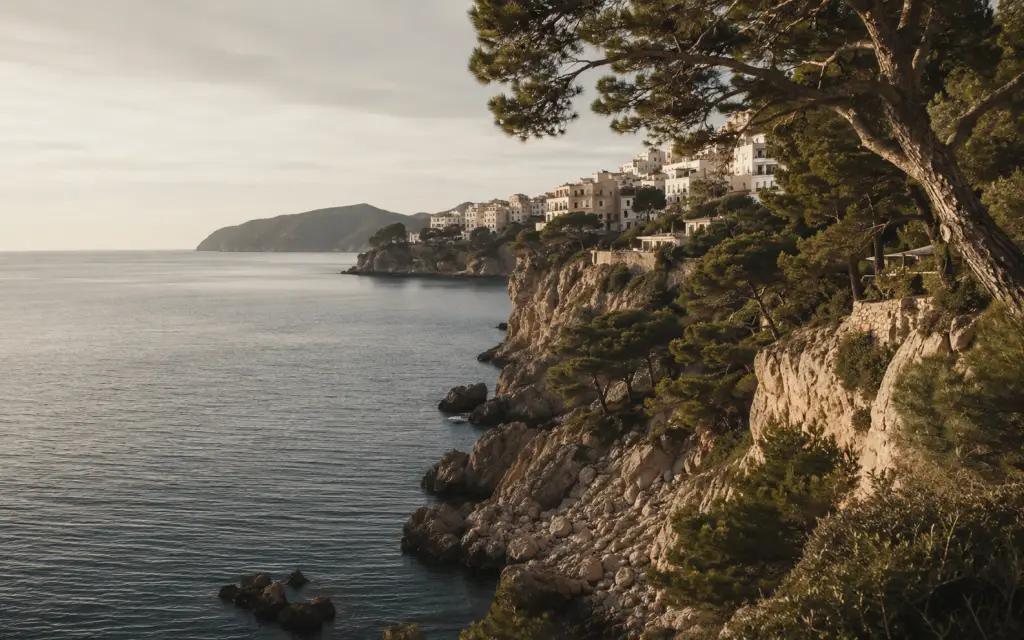
The Costa Blanca is not one property market. It is four, stacked along 150 kilometres of coast, and they differ from each other more than any of them differs from Valencia. Villa prices run from €1,400 per m² in the south to €9,000 per m² on the Benissa cliffs — a six-fold spread inside a single region name. Buyers who search “Costa Blanca” as though it were one place spend months comparing properties that were never alternatives to each other. This guide separates the four markets and says plainly what each one is for.
How to read the coast
Three features of the geography determine almost everything about price and character. Understanding them makes the rest of this guide read quickly.
- The mountains stop just south of Altea. North of that line, the Sierra de Bernia and the Montgó push right down to the sea, producing cliffs, coves, hillside plots and views. South of it, the land flattens into plains and salt lagoons. Topography is the single biggest driver of price on this coast — the northern premium is a premium on terrain, not on sunshine.
- Development happened at different times. The Marina Alta was built out gradually from the 1970s in low-density villa plots. The southern coast was built rapidly from the late 1990s in planned urbanizaciones. That history shows in plot sizes, building density, and how a place feels in February.
- Nationality clusters are real and self-reinforcing. Germans and Dutch concentrate in Moraira, Benissa and Jávea; British across Jávea, Altea and the whole southern coast; Belgians and Scandinavians around Altea and L’Alfàs del Pi; Norwegians distinctly in L’Alfàs. These clusters shape the shops, the restaurants, the clubs and the schools, and they are worth choosing deliberately rather than discovering.
The four sub-markets at a glance
Before the detail, the whole coast in one table. Colour on the left edge carries through the rest of this guide.
| Sub-region | Villa €/m² | Typical buy-in | Stock | Winter life | Buy it for |
|---|---|---|---|---|---|
| Marina Alta Dénia → Calpe |
€2,200–€9,000 | €600K–€900K | Resale, low density | Quiet; Dénia and Jávea hold up | Landscape, privacy, plot |
| Marina Baixa Altea → Villajoyosa |
€1,800–€8,000 | €300K–€500K | Mixed, some new build | Year-round services | Best value per euro of landscape |
| Alicante belt El Campello → Santa Pola |
€1,900–€4,000 | €250K–€450K | Apartments, steady new build | Full urban life, unchanged | Infrastructure, airport, schools |
| Vega Baja Guardamar → Pilar de la Horadada |
€1,400–€3,600 | €200K–€350K | Post-1995, high volume | Varies sharply; verify per urbanización | Modern, low-maintenance, low cost |
Read the “typical buy-in” column carefully — it is the honest answer to “how much do I need”. It is not the cheapest thing available in each sub-region; it is what buys something we would place a client in.
What follows runs from north to south, which is also roughly the order of descending price.
1. Marina Alta — Dénia, Jávea, Benitachell, Moraira, Benissa, Calpe
The premium market, and the reason the Costa Blanca has a reputation at all.
This is where the mountains meet the sea. The Montgó massif behind Dénia and Jávea, the cliffs at Benissa and Benitachell, the coves between Moraira and Calpe — the landscape here is genuinely distinctive rather than generically Mediterranean, and it prices accordingly. Development has been slower and lower-density than anywhere else on the coast, in several municipalities by explicit planning policy.
Indicative 2026 pricing
| Area | Villa €/m² | Apartment €/m² |
|---|---|---|
| Benissa Costa (Fanadix, Buenavista) | €5,500–€9,000 | — |
| Moraira (El Portet, La Sabatera) | €5,500–€8,500 | €3,000–€4,500 |
| Jávea hills (Cap Martí, La Lluca, Tossalet) | €3,500–€7,000+ | — |
| Jávea Arenal / Port | — | €3,200–€5,500 |
| Benitachell (Cumbre del Sol) | €4,800–€6,800 | — |
| Calpe premium hills (La Cometa, Maryvilla) | €4,500–€7,000 | €2,400–€3,800 |
| Dénia (Las Rotas) | €3,500–€5,000 | €2,400–€3,500 |
| Dénia (general) | €2,200–€3,500 | €2,000–€2,800 |
What it is actually like
Low density, private, green, and quiet — including in ways buyers do not always anticipate. Villa life here is dispersed across hillside urbanizaciones with no walkable centre; a car is not optional. The towns themselves are attractive and functional year-round, particularly Dénia and Jávea, which have real Spanish populations rather than purely international ones.
Winter is the test. Moraira and Benitachell quieten substantially between November and March; Dénia and Jávea hold up better. Anyone considering a permanent move should visit in January before committing.
Who it fits
Buyers who want landscape, privacy and plot, who are comfortable driving for everything, and whose budget starts around €600,000 for something genuinely good. Families are well served by two international schools in range — Lady Elizabeth and Xabia International College — as covered in our guide to living here with school-age children.
Go deeper: Moraira, Benissa and Calpe compared · Jávea · Moraira · Calpe
2. Marina Baixa — Altea, Polop, La Nucía, L’Alfàs del Pi, Benidorm, Finestrat
The most varied stretch of the coast, and the best value per euro of landscape.
Altea is the anchor: a genuinely beautiful hilltop old town with a working artistic community, a promenade that people actually walk in winter, and a market that ranges from €2,800 per m² apartments to Altea Hills villas above €8,000. Behind it, Polop, La Nucía and Callosa d’en Sarrià sit in the valley with mountain backdrops and prices roughly half the coastal equivalent.
Then Benidorm, which distorts every conversation about this area. The high-rise strip is small, dense and genuinely useful — it is why this district has a full hospital, large retail, an airport bus, and services that stay open in February when Moraira’s restaurants have shut. Finestrat and the residential hills behind it are quiet and considerably cheaper than anything of equivalent quality further north.
Indicative 2026 pricing
| Area | Villa €/m² | Apartment €/m² |
|---|---|---|
| Altea Hills | €4,500–€8,000 | — |
| Altea town and coast | €3,500–€6,000 | €2,800–€4,500 |
| L’Alfàs del Pi / Albir | €2,400–€3,800 | €2,200–€3,200 |
| La Nucía | €1,900–€3,000 | €1,700–€2,400 |
| Polop | €1,800–€3,500 | €1,500–€2,200 |
| Finestrat / Sierra Cortina | €2,200–€3,500 | €2,000–€3,000 |
| Benidorm | €1,800–€2,800 | €2,000–€3,500 (sea view higher) |
| Villajoyosa | €2,000–€3,000 | €1,800–€2,800 |
Who it fits
Buyers who want mountain-and-sea landscape without Marina Alta pricing, who value year-round services and a hospital fifteen minutes away, and who are not put off by Benidorm existing nine kilometres from their front door. La Nucía specifically has become the default for families with children who play sport seriously, on the strength of its municipal facilities.
It is also the sensible entry point for buyers with €300,000–€500,000 who want quality rather than compromise. That budget buys very little in Moraira and a good deal in Polop or La Nucía.
Go deeper: Altea, Polop and Jávea compared · Altea
3. Alicante and the Campello belt — El Campello, San Juan, Alicante city, Santa Pola
The urban option, and the most under-considered part of the coast.
Alicante is a real city — 340,000 people, a university, an international airport twenty minutes away, an AVE connection to Madrid in two and a half hours, and a working economy that has nothing to do with tourism. Playa de San Juan north of the centre is a long sandy beach with a tram line and a settled residential population. El Campello beyond it is a proper coastal town rather than a resort.
Foreign buyers routinely skip this stretch because it lacks the postcard quality of the north. What it offers instead is infrastructure: two large public hospitals, two strong international schools, year-round urban life, and prices materially below the Marina Alta.
Indicative 2026 pricing
| Area | Villa €/m² | Apartment €/m² |
|---|---|---|
| Playa de San Juan | €2,800–€4,000 | €2,600–€3,800 |
| El Campello | €2,200–€3,400 | €1,900–€3,000 |
| Alicante city centre | — | €2,000–€3,200 |
| Santa Pola | €1,900–€2,800 | €1,700–€2,600 |
Who it fits
Buyers who want city life rather than village life, families who want two credible international schools in range at better value than the north, anyone who flies frequently, and buyers who intend to be here in February as well as July. It is the closest thing on the Costa Blanca to the case for Valencia — and buyers weighing that choice should read our Valencia vs Costa Blanca comparison.
4. Vega Baja and the southern coast — Guardamar, Torrevieja, Orihuela Costa, Rojales, Pilar de la Horadada
The volume market. Lowest prices, newest stock, and the widest quality spread on the coast.
This is where most of the Costa Blanca’s transaction volume happens and where nearly all of the region’s new-build advertising originates. Housing is overwhelmingly post-1995: townhouses, semi-detached quads and modern villas in planned urbanizaciones, laid out around golf courses and commercial centres. Orihuela Costa alone comprises a dozen distinct urbanizaciones — Villamartín, Campoamor, La Zenia, Playa Flamenca, Cabo Roig — each with its own character and price level.
The foreign resident population here is the largest in Spain by concentration, which produces genuine practical advantages: English is spoken everywhere including at the hospital, international schools are cheaper than anywhere else in the region, and the infrastructure is built for exactly this population.
Indicative 2026 pricing
| Area | Villa €/m² | Apartment / townhouse €/m² |
|---|---|---|
| Cabo Roig / Campoamor (front line) | €2,400–€3,600 | €2,200–€3,000 |
| Orihuela Costa (general) | €1,800–€2,500 | €1,600–€2,300 |
| Guardamar del Segura | €1,800–€2,600 | €1,600–€2,300 |
| Rojales / Ciudad Quesada | €1,600–€2,400 | €1,400–€2,000 |
| Torrevieja | €1,500–€2,300 | €1,400–€2,200 |
| Pilar de la Horadada | €1,600–€2,400 | €1,400–€2,100 |
The honest assessment
We place clients here, and we do so selectively. The value proposition is real — €300,000 buys a new three-bedroom villa with a pool here and a two-bedroom apartment in Moraira. The risks are equally real and specific:
- Seasonal emptiness. Many urbanizaciones run at 25–35% winter occupancy. Choosing a development with a genuine year-round resident population matters more here than anywhere else on the coast, and it is not visible from a listing.
- Homogeneity of stock. When 300 near-identical properties exist within two kilometres, resale is competitive and price growth is capped by supply. This is a use-it market more than an appreciation market.
- Build quality variance. The 1998–2007 boom produced both careful construction and very poor construction, sometimes on adjacent streets. A structural survey is not optional here.
- Landscape. Flat, and largely built. Buyers arriving from the Marina Alta usually notice within an hour.
Who it fits
Buyers whose budget is €200,000–€400,000 and who want a modern, low-maintenance property rather than a project. Retirees who value English-language services and flat, walkable terrain — a genuine consideration at 75 that does not register at 55. Families choosing El Limonar or CBIC on school fees. Buyers for whom golf is a primary reason for being here.
The whole coast, ranked by price
Villa €/m² in the premium zone of each area, 2026. Each bar spans the area’s actual range — where it starts matters as much as where it ends. Colour marks the sub-region.
Marina Baixa
Alicante belt
Vega Baja
Bars are capped at €9,000. Jávea hills is ranked above Calpe despite the same €7,000 upper figure because its best plots trade open-ended above it — the only area in the chart without a firm ceiling.
Two things the chart makes visible that a ranked list hides.
The four sub-regions genuinely separate. Marina Alta occupies the top of the scale almost exclusively; Vega Baja sits at the bottom with no overlap into the premium tier at all. That is the argument of this whole article, drawn rather than asserted — these are not variations of one market, they are four markets that happen to share a name.
But the middle is crowded. Look at where the bars start rather than where they end. Between roughly €2,200 and €3,500 per m² sit Finestrat, El Campello, Polop, La Nucía, Cabo Roig and the bottom of Jávea and Altea — six areas from all four sub-regions, competing directly. The standard residential tier is compressed into a narrow band almost everywhere. The six-fold spread happens at the top of each market, not in the middle. A buyer looking for a comfortable, unspectacular family house will find the difference between Calpe and Guardamar far smaller than the headline figures suggest.
Matching profile to sub-region
| If your priority is… | Look at |
|---|---|
| Landscape, privacy, plot — budget above €700K | Moraira, Benissa, Jávea hills |
| Beauty and character at moderate cost | Altea, Dénia, Villajoyosa |
| Best value for mountain-and-sea setting | Polop, La Nucía, Callosa |
| Year-round services and hospital proximity | Benidorm, Finestrat, L’Alfàs del Pi |
| City life, airport, urban amenities | Alicante, Playa de San Juan, El Campello |
| Families with international school priority | Jávea, El Campello, Altea / L’Alfàs |
| Modern low-maintenance property under €400K | Orihuela Costa, Guardamar, Rojales |
| English-language everyday life | Orihuela Costa, Torrevieja, Jávea |
| Golf as a primary reason | Villamartín, Campoamor, La Finca, Las Colinas |
| German or Dutch community | Moraira, Benissa, Dénia |
| Scandinavian community | L’Alfàs del Pi, Albir, Altea |
| Rental yield as a meaningful factor | Benidorm, Alicante, Jávea Arenal |
Where we usually steer clients away
Not places — situations. Each of these appears across the whole coast and each one is easier to avoid than to unwind.
- Urbanizaciones with unresolved legal status. A minority of developments from the boom years still carry planning irregularities or incomplete infrastructure handover. The community’s accounts and the town hall’s records tell the story; the listing does not.
- Remote hillside plots with a single access road. Beautiful, and a real problem at 78 — or during a fire, or when an ambulance is coming up. Our healthcare guide sets out the drive times to each hospital on this coast.
- Front-line beach apartments in high-turnover blocks. Attractive to buy, tiring to own — short-term rental churn, noise, and community meetings dominated by absent owners.
- Off-plan from developers without a track record. Bank guarantees exist for a reason and are not universally provided as they should be. Our off-plan versus resale guide covers what to verify before any deposit.
- Any property bought without visiting in winter. The most common and most expensive mistake on this coast.
New build or resale, by area
Availability differs sharply between the four sub-regions, and it constrains the search more than most buyers expect.
- Marina Alta: limited new build, mostly at Cumbre del Sol in Benitachell and scattered individual villas. Buildable plots are scarce and municipalities restrict density. Overwhelmingly a resale market.
- Marina Baixa: moderate new build in Finestrat, Sierra Cortina and La Nucía. Altea itself has very little.
- Alicante belt: steady apartment development in Playa de San Juan and El Campello.
- Vega Baja: the bulk of the region’s new build, in continuous supply. If you want a brand-new property with an LOE warranty and a ten-year structural guarantee, this is where the choice is.
For the full comparison of deposits, bank guarantees, timelines and risk, see our off-plan versus resale guide and the new-build market overview.
FAQ
Which is the best area to buy on the Costa Blanca?
There is no single best area, because the coast contains four different markets serving different buyers. For landscape and privacy with a budget above €700,000, the Marina Alta — Moraira, Benissa, Jávea. For character at moderate cost, Altea and Dénia. For year-round services and value, the Marina Baixa inland towns. For modern property under €400,000, the southern coast around Orihuela Costa. The question that matters is which of those descriptions is yours.
Where is the most expensive part of the Costa Blanca?
The Benissa Costa cliffside — Fanadix and Buenavista — at €5,500–€9,000 per m² for quality villas, with Moraira’s El Portet and Altea Hills immediately behind. These three zones sit clearly above everything else on the coast.
Where is the cheapest place to buy on the Costa Blanca?
The southern Vega Baja — Torrevieja, Rojales and Ciudad Quesada — where villas run €1,500–€2,400 per m² and apartments from around €1,400. Inland Marina Baixa towns like Polop and La Nucía offer comparable value with substantially better landscape, and are worth comparing before deciding.
Is the north or the south of the Costa Blanca better?
The north has the landscape, the lower density and the higher prices. The south has newer stock, flat walkable terrain, the strongest English-language infrastructure and prices roughly half the north’s. Neither is better in the abstract. Buyers who prioritise setting choose north; buyers who prioritise budget, convenience and low maintenance choose south.
Which Costa Blanca areas are good for year-round living rather than holidays?
Dénia, Jávea, Altea, Villajoyosa, El Campello and Alicante all maintain genuine year-round populations with services that stay open through winter. Moraira, Benitachell and much of Orihuela Costa quieten considerably between November and March. This is the single most important thing to verify in person, in winter, before buying.
How much do I need to buy a decent property on the Costa Blanca?
Realistically: €200,000–€350,000 for a modern villa or townhouse in the south; €350,000–€550,000 for a good apartment or a modest villa in the Marina Baixa; €600,000–€900,000 for a genuinely good villa in Jávea, Calpe or Dénia; €900,000 upwards for the premium zones of Moraira, Benissa and Altea Hills. Add roughly 12–14% for purchase costs — the full breakdown is in our cost of buying guide.
Which Costa Blanca areas have international schools?
Jávea and Benitachell (Xabia International College, Lady Elizabeth), L’Alfàs del Pi (Sierra Bernia), Benidorm (Lope de Vega), El Campello (Newton College, British School of Alicante), Elche (King’s College Alicante) and Orihuela Costa / Rojales (El Limonar, CBIC). Full detail on fees and curricula is in our international schools guide.
Is the Costa Blanca a good investment in 2026?
It is a good place to own a property you will use. As a pure investment it is uneven: the premium northern zones have limited supply and hold value well, while the southern volume market has abundant supply that caps appreciation. Rental yields are strongest in Benidorm, Alicante and the Jávea Arenal, where demand runs closer to year-round. We would not advise buying anywhere on this coast on appreciation assumptions alone.
Sources and further reading
- Colegio de Registradores — official property registry transaction data, including foreign buyer share by province
- Instituto Nacional de Estadística — housing price index and municipal population data
- Ministerio de Vivienda y Agenda Urbana — national housing statistics and appraised value series
- Generalitat Valenciana — regional planning and municipal records
Where to start
Most buyers arrive at the Costa Blanca with a shortlist of towns collected from holidays and search portals, and the towns on it usually belong to two or three different markets. The more useful first step is deciding which of the four sub-regions your priorities actually point to — then the town-level choice becomes a short conversation rather than a long search.
Altea, Polop and Jávea in depth · Moraira, Benissa and Calpe in depth · Valencia vs Costa Blanca · Tell us what you’re looking for.